Author: Splijtstof

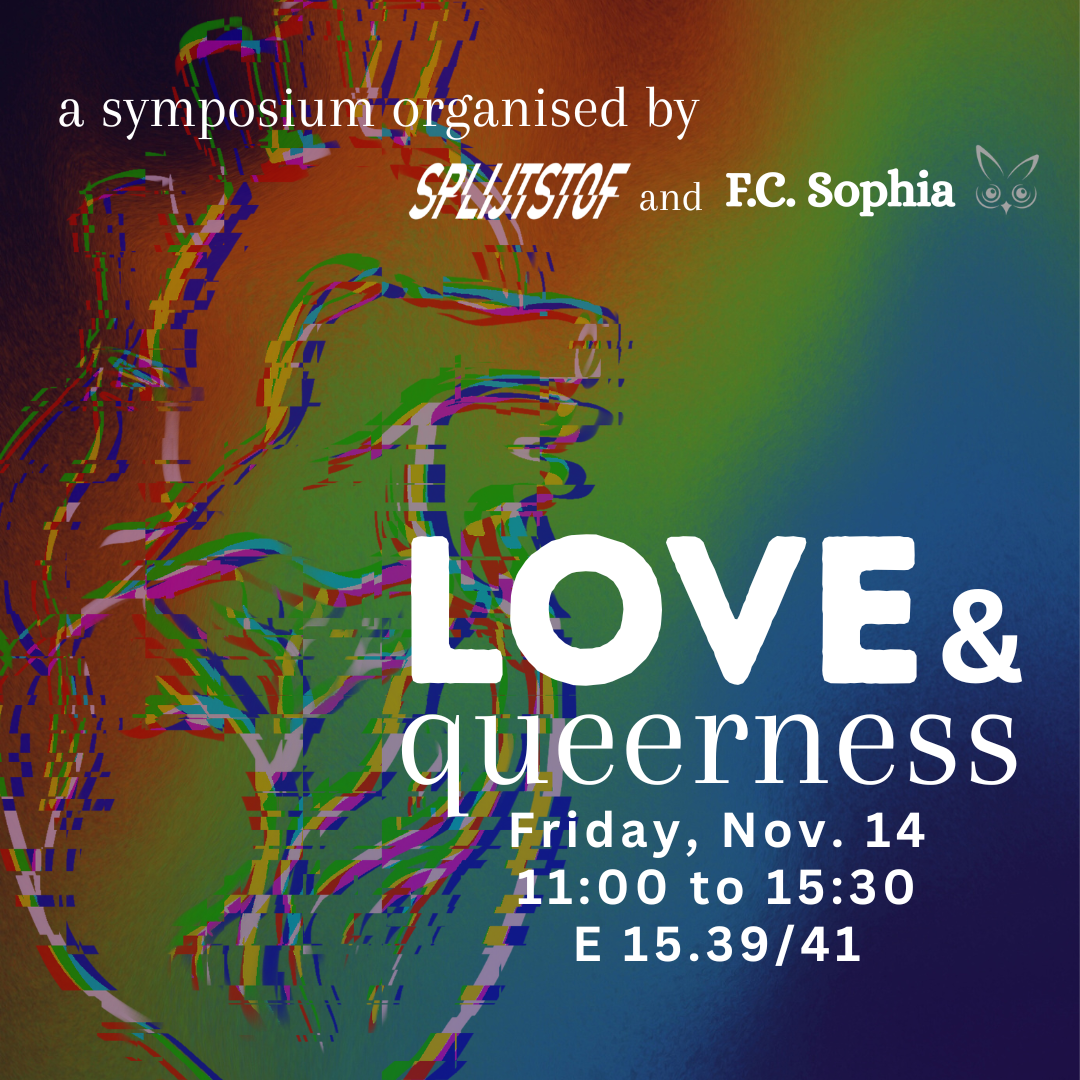
  • Love & Queerness: Symposium with Splijtstof and F.C. Sophia

    Splijtstof and F.C. Sophia invite you to join this year’s symposium!
    The theme is “Love & Queerness” and we have put together a truly interesting and inspiring line-up of speakers. There will be a workshop, lectures, a poetry recital and lots of space for your own questions.

    So join us on Friday, November 14 from 11:00 to 15:30 in E. 15.39/41.
    Feel free to (quietly) come in at any point during the day. Registration is not requried but please note that seating and space are limited.

    Schedule:

    11:00 Welcome Snacks and Walk-In
    11:15 Love Letter Workshop with author-in-residence Benny Lindelauf
    12:30 Dr. Guilel Treiber: “Queer Experiences: Rereading Foucault’s History of Madness”
    13:15 Break
    13:35 Dr. Rae Aumiller: “Queer Hesitation and Sensation: Navigating Embodied Consent and Doubt” + Discussion with Charlie Chowdhry
    14:20 Poetry Recital by Michael Grooff
    14:50 Ilyasse Ouanani: “What is Platonic Love? Eros in the Lysis, Symposium, and Phaedrus”
    15:30 Ending and Drinks at Cultuur Café

    We are excited to welcome you at the event!
    For more information, you can find the lecture abstracts below.

    Dr. Guilel Treiber: “Queer Experiences: Rereading Foucault’s History of Madness”
    Foucault’s The History of Sexuality: The Will to Knowledge is the foundational text of Queer theory. However, it comes with a problematic legacy, specifically one related to a somewhat flat understanding of identity. This has been noticed and commented on extensively. However, the first volume of The History of Sexuality cannot be taken to be Foucault’s final words on the issue of sexuality. Lynne Huffer makes a convincing claim for why a theory of Queer experience cannot develop from its founding text, but rather must return to the early History of Madness. In this lecture, I will explain this peculiar argument and develop it further by pitting psychoanalytical inspired queer theories against those which sees psychoanalysis, and psychology in general, as part of what Queer theory, and specifically, Queer experience, needs to keep a distance from.

    Dr. Rae Aumiller: “Queer Hesitation and Sensation: Navigating Embodied Consent and Doubt”
    → Read Rae’s paper in preparation for their presentation here.
    In her response to Levinas in “The Fecundity of the Caress,” Luce Irigaray describes a kind of heightened responsiveness that begins from a space of isolation “before the caress.” The caress before the caress is a space of suspended self-certainty, in which touch may question itself. The caress before the caress indicates a relationship to intimacy underlying each instance of touching, which that touch cannot fully grasp. This talk locates a queer, feminist ethics of intimacy, born from experiences of isolation, waiting, disrupted belief, and suspended desire. 

    Ilyasse Ouanani: “What is Platonic Love? Eros in the Lysis, Symposium, and Phaedrus”
    Talk of Platonic love abounds in our contemporary world, but what might such a love actually be? Following this question, this talk proposes to trace the theme of Eros through the Lysis, Symposium, and the Phaedrus. Plato’s dialogues are rife with sexual innuendo, tension, and desire. How does this fit with our common conception of Platonic love as asexual or celibate? Plato sublimates desire, love, into philosophy. What does this look like? I propose, against most scholars, that the Lysis is an erotic dialogue. Socrates answers the question of a demonstration in erotic conversation by engaging in dialectic, because this is erotics for Plato. In the Symposium, love returns as elevation in the famous ‘ladder of love’, elevation to the mysterious Forms. In the Phaedrus, love is presented as mutually beneficial if its sexual attraction is properly rerouted towards philosophy. Throughout these dialogues, Plato turns seduction and sexuality into philosophical practice, he socratizes sex. As such, the philosopher’s love and desire are never fulfilled but perpetually frustrated, and this frustration becomes the engine of thought. Platonic love is not sexless then, but rather rethinks sex in order to make it useful to the aims of philosophy.

  • Splijtstof Student Conference: Submission Information and Criteria

    The editors-in-chief at Splijtstof are excited to invite Splijtstof editors and all other students to submit abstracts for philosophical conference papers written on the theme of ‘Disease’. The conference will take place on December 4, 2025. We can accommodate your requests with regards to the relative timing of your presentation on the day (e.g. you can present later if you have a class). All finished conference papers, regardless of whether or not they are presented at the conference, will be published in a special Conference Edition of Splijtstof.
    We are looking for submissions from Bachelor, (Pre)-Master and Research Master students. You are welcome to work together with other students on a conference paper as long as every contributor is named as an author. Submissions should be written in English.

    The use of Generative AI and/or Large Language Models (e.g. ChatGPT) is strictly forbidden at every stage in the writing and editing process.

    Unfortunately, to ensure that this rule is adhered to, we must ask you to write your abstract and your paper entirely in Google Docs, so that we can look at the version history. If we cannot see the version history, we will not be able to accept your abstract or allow you to present your paper at the conference.
    Please send an edit link to your finished work, in a timely manner, to redactie@splijtstof.com. The following dates are hard deadlines.

    Timeline

    October 20, 23:59 – Abstract Submission Deadline
    October 23 – Acceptance Notification
    November 20, 23:59 – Final Version Submission Deadline

    Presentations

    Each conference presenter has 30 minutes to use as they see fit. You should be prepared to present your paper and answer some questions from the audience. If you wish, you may present for a shorter time and use the remainder of your time to guide the audience through a plenary discussion or activity designed to assimilate the content of your conference paper.
    You will not be able to use a slideshow or powerpoint presentation. You are welcome to provide the audience with printed handouts (relevant artwork, instructions for an activity and such), but in the interests of sustainability, we ask you to consider only printing handouts if it is strictly necessary. If you would like to have images on a screen behind you as you present, please send a
    maximum of 5 images alongside your Google Docs link submission (N.B. send the images as separate attachments, not just embedded in your Google Document).

    Abstract requirements


    250 words with a 10% margin, excluding the (working) title and references.
    It should work with the theme of ‘Disease’. You are free to interpret the theme however you wish; both straightforward and creative engagements with this theme are welcome.
    Your abstract (and final paper) should be philosophical. This will mean something different from person to person. We are happy to receive submissions from writers with a non-philosophical background. Write with your own understanding of philosophy in mind.

    Other requirements

    If you plan on going beyond the presentation & question round structure, please use a subheading under your abstract to explain your plan. It will not count towards the word limit, but nevertheless, please be brief.
    Please include your first name, last name, pronouns and current degree programme with your submission, along with any relevant previous education or research interests that relate to your paper. We will use this information to introduce you as a speaker during the conference.

    Review process

    For Splijtstof editors:
    Due to the nature of the submission process, we cannot review your abstract anonymously. The editors-in-chief will review your abstract themselves rather than with the wider Splijtstof editorial team.

    For external participants:
    The editors-in-chief will be aware of who has written which abstract, but the abstracts will be presented anonymously to the rest of the Splijtstof editorial team for review.

    Relevant for all participants:
    When we review your abstract, we are looking for a clear link to the theme of ‘Disease’, a philosophical approach, a description of the structure and methodology of your completed conference paper, and (if relevant) a well thought-out description of your plan for your additional activity or discussion.
    Some papers translate better to a conference setting, and this is another factor we will consider when reviewing the abstracts. In celebration of your hard work, we will be publishing a
    Conference Edition following the event, and every abstract and paper submitted for the conference will be featured, regardless of whether or not the paper was presented during the conference. Thus, it is still worth continuing to work on your conference paper even before you have received the acceptance notification, since it has a place in the Conference Edition of Splijtstof regardless of the verdict.

    Questions/Contact
    You are welcome to contact the editors-in-chief of Splijtstof by email at redactie@splijtstof.com.

  • Splijtstof 53-1

    You will be redirected to the PDF file in a matter of seconds…
  • RAGweek Nijmegen Events in Collaboration With Splijtstof

    Alongside Radboud University’s Faculty of Philosophy, Theology and Religious Studies Student Council and the faculty’s student associations, F.C. Sophia and Awaz, the Splijtstof team has organised two exciting new events in collaboration with RAGweek Nijmegen.

    RAGweek Nijmegen is affiliated with the RAGweek foundation, an organisation dedicated to raising funds for, and awareness of, two charities each year: one based in the Netherlands and one based abroad. This year, the chosen Dutch charity is Stichting Kinderfeest, and the international charity is Bring the Elephant Home (Africa & Asia).

    Accordingly, we are thrilled to officially announce our involvement in the following events:

    April 9, 2025RAGweek Charity Market
    Come along to shop at various market stalls offering baked goods, art, and much more. Funds raised will be handled by RAGweek Nijmegen and distributed to this year’s chosen charities outlined above.
    12:15 – 13:30
    Radboud University’s Erasmus Square
    April 11, 2025RAGweek Colloquium and Feedback Event
    Present your (unfinished) research to a small audience and receive constructive feedback! You can also leave a printed-out copy of your writing with the Editors-in-Chief of Splijtstof (English) or our Dutch-language editor, and we will provide suggestions and corrections. Pay-what-you-can donations to RAGweek are greatly appreciated.
    12:00 – 18:15
    Radboud University’s Erasmus Building, E15.39/41

    Questions?

    What if I don’t want to present anything at the colloquium but would love to hear about ongoing student and staff research in the FTR faculty?

    Come along and join the discussion!

    I would like to present at the colloquium, but I don’t know what is expected of me. What should I prepare?

    We welcome research presentations in any form! The colloquium is a relaxed environment where you are welcome to present any research, at any stage, in any form. You can prepare as much or as little as you would like. We do not expect to receive any documents from you beforehand, but if you would like to make a donation to RAGweek Nijmegen in exchange for editing and proofreading services from our Editors-in-Chief, a printed copy of your writing would be appreciated.

    From whom can I receive feedback at the colloquium?

    A variety of FTR researchers, professors and lecturers have been invited to the event as guests. You can also receive feedback from your fellow students, alongside the Splijtstof editorial team.

    What if my question is not listed here?

    You can contact the Editors-in-Chief of Splijtstof via email at redactie@splijtstof.com.

    External Links

    RAGweek Nijmegen: https://www.ragweeknijmegen.nl/.

    Stichting Kinderfeest: https://stichtingkinderfeest.nl/.

    Bring the Elephant Home (Africa & Asia): https://bring-the-elephant-home.org/.

  • Splijtstof Student Conference: ‘Fantasy’

    28
    November2024
    Splijtstof Student Conference: ‘Fantasy’
    10:00 – 17:00Radboud University’s Erasmus Building: E15.39/41

    The Splijtstof Editorial Team is proud to present their first student conference, based on the theme of ‘Fantasy’!

    You are invited to attend a day of philosophical inquiry into ‘Fantasy’ and its manifestations in various specialisations, from object-oriented ontology, critical disability studies, philosophy of technology, animal ethics, political philosophy and much more. The event will take place from 10:00 – 17:00 on November 28, 2024, in Radboud University’s Erasmus Building (E15.39/41). It will be moderated by Dr. Rae Aumiller (Metaphysics and Philosophical Anthropology), Tim Miechels (PhD Candidate in Metaphysics and Philosophical Anthropology) and Sophie Ingle (Ethics and Political Philosophy).

    The Splijtstof Student Conference has been organised in collaboration with Tim Miechels.


    Schedule

    10:00 – Welcome

    10:10 – 10:40 – Jonathan Zackor – An Infinite Present Without Consequences: The Absurd Promise of Liminal Space

    10:50 – 11:20 – Marleen van Haalen – The Realness: What the Fantasy of Drag Can Teach Us About Reality

    11:30 – 12:00 – Panel Discussion on ‘Fantasy’, Drag and Reality with Dr. Rae Aumiller, Tim Miechels, Marleen van Haalen and Charlie Chowdhry

    12:00 – 13:00 – Lunch

    13:00 – 13:30 – Charlie Chowdhry – Disabled Dreams of Accessible Academia: Fantasy, or Feasible?

    13:40 – 14:10 – Saar Boter – Frutiger Aero: A Fantasy of a Better Future

    14:20 – 14:50 – Sophie Ingle – Phenomenological Reflections on Donaldson and Kymlicka’s Liminality in a Fantasy World of Pokémon

    14:50- 15:10 – Break

    15:10 – 15:40 – Susana Reis – CRISPR and The Fantasy of Human Immortality: Using Imagination to Assess This Possibility

    15:50 – 16:20 – Jacque Marliin – Narrating Self-Destruction: Hegemony and Nihilist Strategy
    An Alternative Interpretation of David Fincher’s Fight Club

    16:30 – 17:00 – Mark den Dekker – The Fantasy of Capitalism: How Capitalist Ideology is Literally Magic

    17:00 onwards – Drinks in the CultuurCafé

  • Splijtstof 52-4

    You will be redirected to the PDF file in a matter of seconds…
  • Splijtstof Student Conference: Call for Abstracts

    The editors-in-chief at Splijtstof are excited to invite Splijtstof editors and all students of the FFTR to submit abstracts for philosophical conference papers written on the theme of ‘fantasy’. The conference will take place on November 28, 2024, at E15.39/41. We can accommodate your requests with regards to the timing of your presentation. All finished conference papers, regardless of whether or not they are presented at the conference, will be published in a special Conference Edition of Splijtstof. 

    We are looking for submissions from Bachelor, (Pre)Master and Research Master students. You are welcome to work together with other students on a conference paper as long as every contributor is named as an author. Submissions should be written in English. 

    Please submit your abstract as a .docx file, in a timely manner, to redactie@splijtstof.com. The following dates are hard deadlines. 


    Timeline

    October 7 – Abstract Submission Deadline

    October 11 – Acceptance Notification

    November 14 – Final Version Submission Deadline

    Presentations

    Each conference presenter has 30 minutes to use as they see fit. You should be prepared to present your paper and answer some questions from the audience. If you wish, you may present for a shorter time and use the remainder of your time to guide the audience through a plenary discussion or activity designed to assimilate the content of your conference paper. 

    You will not be able to use a slideshow or powerpoint presentation. You are welcome to provide the audience with printed handouts (relevant artwork, instructions for an activity and such), but in the interests of sustainability, we ask you to consider only printing handouts if it is strictly necessary. 

    Abstract requirements

    250 words with a 10% margin, excluding the (working) title and references. 

    It should work with the theme of fantasy. You are free to interpret the theme however you wish; both straightforward and creative engagements with this theme are welcome. 

    Your abstract (and final paper) should be philosophical. This will mean something different from person to person. We are happy to receive submissions from writers with a non-philosophical background. Write with your own understanding of philosophy in mind. 

    Other requirements

    If you plan on going beyond the presentation & question round structure, please use a subheading under your abstract to explain your plan. It will not count towards the word limit, but nevertheless, please be brief. 

    Please include your first name, last name, pronouns and current degree programme with your submission, along with any relevant previous education or research interests that relate to your paper. We will use this information to introduce you as a speaker during the conference. 

    The FFTR’s rules concerning plagiarism, academic integrity and the use of Generative AI apply to this conference. That is, write with integrity and do not have anything or anyone else do it for you. 


    Review process

    For Splijtstof editors: 

    Due to the nature of the submission process, we cannot review your abstract anonymously. The editors-in-chief will review your abstract themselves rather than with the wider Splijtstof editorial team. 

    For external participants: 

    The editors-in-chief will be aware of who has written which abstract, but the abstracts will be presented anonymously to the rest of the Splijtstof editorial team for review. 

    Relevant for all participants: 

    In your abstract, we are looking for a clear link to the theme of fantasy, a philosophical approach, a description of the structure and methodology of your completed conference paper, and (if relevant) a well thought-out description of your plan for your additional activity or discussion. 

    Some papers translate better to a conference setting, and this is another factor we will consider when reviewing the abstracts. In celebration of your hard work and a significant Splijtstof milestone, we will be publishing our first Conference Edition following the event, and every abstract and paper submitted for the conference will be featured, regardless of whether or not the paper was presented during the conference. Thus, it is still worth continuing to work on your conference paper even before you have received the acceptance notification, since it has a place in the Conference Edition of Splijtstof regardless of the verdict. 

    Questions/Contact

    You are welcome to contact the editors-in-chief of Splijtstof by email at redactie@splijtstof.com.

  • The (Un)freedom of Dutch Housing

    In the Netherlands, there is a housing crisis. This fact has been so unanimously agreed upon that it even became one of the main spearpoints in the 2023 Dutch elections under the moniker of ‘bestaanszekerheid’, or security of living (NOS 2023). The main problems that make up this crisis are the scarcity of available housing and the price of housing that is available. Citizens looking into purchasing a house are often outbid, and those applying for social housing are placed on waiting lists that may take up to 17 years in some municipalities (Buijtendijk & Buijs 2023). One of the main driving forces in this housing crisis is the privatisation of the housing market during the 90s (Kras 2022). This privatisation was aimed at providing more citizens with cheaper housing due to competition on the open market. Privatisation also meant there would be less social housing and more opportunities for house ownership. Why is it that the liberalisation of the housing market, which would give citizens more opportunities and freedom regarding housing, has made many citizens unfree due to their inability to find a stable place to live?

    ​A central turning point often mentioned regarding housing in the Netherlands is the 1990s (Kras 2022). Before this period, it was often the case that municipalities owned large pieces of land and willingly distributed these to housing associations eager to start building affordable, accessible housing. This meant municipalities had control over the amount, size, and specifications of new housing. An inevitable shift occurred during the 1990s when the citizen became important as an individual and consumer. Citizens had specific, personal wishes and desires, which also affected their perspective on the role of housing in society. Creating considerable diversity in housing types and fulfilling more specific wishes regarding lifestyle became central. Adding to this, providing citizens with the ability to own a house privately became a central political goal (Haas, Heerink, and DWARS Commissie economie, n.d., 12). To fulfil these goals, municipalities sold their shares in land and housing projects, thus privatising the housing market.

    ​This tendency in economic politics is also considered to be a shift from socialist politics towards a more liberal mindset. Liberalism, as an ideology, focuses on personal freedom and the freedom to conceive of your own personal idea of ‘the good life’. This is also often referred to as the idea of negative freedom. With negative freedom, citizens are free to decide for themselves and free from interference from others (or the state). Negative conceptions of freedom also stimulated the liberalisation of the housing market. Citizens would be able to choose a living space that best suits their taste. Thus, by focusing on providing more options (type and size of a house, private or social housing, etc.), a citizen’s personal freedom is increased. While on paper, citizens are free to choose what kind of housing they desire, in practice, they do not have the ability to actually express this freedom. Due to privatisation, housing prices have increased, and the availability of housing has decreased, which has, in practice, made citizens less free. In this sense, citizens are forced to apply to any social housing projects that remain or apply for a mortgage that limits their financial mobility significantly. While liberalism proposes an ideology of personal choice and freedom, the practical consequence is that citizens have become less free.

    ​A potential opening to escape this deadlock in housing is finding a different conception of freedom, namely, positive freedom. Positive freedom is generally conceptualised as the idea that citizens have the freedom to actualise the possibilities given to them (Warburton, n.d.). Positive freedom focuses on the ability to make a specific choice. This is opposed to a liberal conception of freedom, which focuses on the opportunity to make choices, not your actual capacity to make choices. Hegel suggested that free will is actualised through the choices that individuals and collectives make; therefore, being able to actualise choice is more an expression of freedom than the opportunity to make choices. A housing market focused on positive liberty is thus focused on realising citizens’ ability to receive housing, instead of providing irrelevant possible choices. This would, for example, lessen possible options in housing but make the options that are there more accessible.

    To provide some perspective, this idea has already been realised in Austrian social housing (VPRO 2023). In Austria, over 80% of citizens are eligible for social housing and pay comparatively little for their housing. In the Dutch context, social housing is seen as something for ‘the poor’ and is generally seen as undesirable. This is completely reversed in the Austrian context. Citizens see social housing as something positive and that it does not entail living in poor or inadequate housing. Positive freedom, when translated into providing as many citizens as possible with adequate housing, causes innovative and livable housing options to arise (VPRO 2023).

    Additionally, other opportunities open up by providing more citizens with suitable housing. Since citizens can now access housing more easily, they may also have better job opportunities and access to social and community participation. Thus, by providing accessible housing, citizens have more choices that are open to them, and become, in turn, freer. Citizens in this situation are less restricted and gain opportunities instead of losing them.

    ​While the housing crisis in the Netherlands may seem like a purely practical or technical problem, it is, in actuality, fueled by a specific, negative conception of freedom. Therefore, the housing crisis problem can only be resolved by adopting a new conception of freedom. This can be found in positive freedom, which focuses on capabilities instead of opportunities. Additionally, housing based on positive freedom has already been realised in Austria, which could serve as an example for the Netherlands to tackle its housing crisis.


    Bibliography

    Buijtendijk, Richard, and Madeline Buijs. 2023. “In Nederland sta je eindeloos op de wachtlijst voor een sociale huurwoning.” Colliers, October 5, 2023. https://www.colliers.com/nl-nl/research/factcheck-in-nederland-sta-je-eindeloos-op-de-wachtlijst-voor-een-sociale-huurwoning.

    Haas, Raoel, Vincent Heerink, and DWARS Commissie economie. n.d. “Waarom de huizenmarkt altijd faalt. Een economisch-historische analyse van huisvesting, marktfalen en woningcorporaties.” Accessed August 20, 2024. https://dwars.org/wp-content/uploads/2023/04/Manifest-Volkshuisvesting.pdf.

    Kras, Jeanette. 2022. “Waarom oplossen woningcrisis zo moeilijk is: ‘We zitten gevangen in het systeem.” Welingelichte Kringen, January 5, 2022. https://www.welingelichtekringen.nl/economie/3158548/waarom-oplossen-woningcrisis-zo-moeilijk-is-we-zitten-gevangen-in-het-systeem.html.

    NOS. 2023. “Bestaanszekerheid is een belangrijk thema voor veel kiezers.” NOS, November 5, 2023. https://nos.nl/collectie/13960/video/2496803-bestaanszekerheid-is-een-belangrijk-thema-voor-veel-kiezers.

    VRPO. 2023. “expeditie beter Nederland.” Last modified November 30, at 20:30 (CET). https://www.vpro.nl/programmas/tegenlicht/kijk/afleveringen/2023-2024/Expeditie-beter-Nederland.html.

    Warburton, Nigel. n.d. “Two Concepts of Freedom.” OpenLearn. Accessed August 20, 2024. https://www.open.edu/openlearn/history-the-arts/philosophy/two-concepts-freedom/content-section-3.3.

  • Dress to Impress: Communicating Knowledge and Power Through Fashion

    If he had not worn that borrowed blazer from Princeton University, Dickie Greenleaf would not be dead. In the movie The Talented Mr. Ripley (1999), Thomas Ripley fakes having attended Princeton to be accepted into the high society of New York. As part of his ruse, he flies out to Italy to visit Dickie Greenleaf, a true bon vivant living his life partying. Trying to survive in the world of the rich and pretty, Ripley has to adapt by wearing the clothes worn by high society. After rising suspicions from Greenleaf’s side, they get into a fight and Ripley kills Greenleaf. Based on the book with the same title (1955), the story follows a con-artist who desperately yearns to be part of the upper class and uses clothes to uphold his scheme. Similarly, earlier this year, the ‘old money style’ trend reemerged, with people attempting to emulate the fashion choices of the contemporary upper class. This essay entails a discussion of class distinction through clothing.

    We will argue that clothes can be used as a means of communication, transmitting knowledge about status, belonging or political statements. After explaining the term ‘old money style’, we will speculate that the style (re)gained popularity earlier this year, because its conservative roots give safety and its classic, basic look is in line with the demands for a more timeless wardrobe in the face of a climate crisis. Giving an outline of the theory of proletarianization from Marx and Engels, and adding to it with Stiegler’s notion of lack of knowledge, we will combine this theory with fashion. Firstly, clothing is used as a class distinction, shown in the example of the ‘old money style’ trend and the more concrete example of the ‘suit’ apparel. Secondly, in contrast to the desire of dressing like the upper classes, dressing in opposition to them as a political statement is explained with the example of Black people and their reclaiming of ‘Hip Hop culture’ from those who have devalued or appropriated it. Hereby the problematic, ignorant use and capitalization on the Hip Hop ‘style’ by white brands is highlighted, because the meaningful aspect of the clothes is disregarded. Having explained why clothes can be a form of communication, we will argue that choosing to not care about this communication is a form of privilege resulting from class, economic context, conventional attractiveness or fame. Furthermore, we will argue on the example of the con-artist Anna Sorokin that, apart from mere clothes, context is important. Aspects of whom the wearer is, how the garment is worn and when must also be considered when analyzing communication through clothes.

    ‘Old Money Style’

    The ‘old money style’, or ‘old money aesthetic’, is a recent clothing trend of people wanting to dress in an elegant and classic style, imitating the fashion choices of upper-class wealthy people with a grand family tree and set traditions. Popular clothing items are cable knit sweaters, linen pants, boat shoes, polo shirts, oxford shirts and navy blazers (Berlinger 2024, n.d.). As the names already suggest, the clothes are tied to a certain kind of lifestyle – having a boat, playing polo and going to esteemed universities like the University of Oxford. The specific look, worn by the likes of the Windsor family or John F. Kennedy, is based on the already existing ‘preppy’ style. ‘Prep’ stems from American and English preparatory schools, which are private schools for children who want to go to college or university (Lingala 2013, 4). The style is said to have originated in the late 19th century (Lingala 2013, 2), when the upper class could afford to study classical programs instead of having to work. This class of White Anglo-Saxon Protestants, henceforth referred to as WASPs, were proud of their family history and wanted to distinguish themselves from the people who got rich through the Industrial revolution in the 19th century, marking the beginning of the separation of ‘old money’ and ‘new money’ (Lingala 2013, 8).

    The question arises – why now? Why did the trend of ‘old money’ reemerge at this particular moment? On Tik Tok, the hashtag #oldmoney has over 600,000 posts (June 2024) and on Instagram, the hashtag has over a million posts (June 2024). Additionally, the search expression ‘old money style’ gained a sudden, steep rise in interest around late February of 2024 (Google Trends, n.d.). Two connected reasons could be responsible for that. Firstly, the ‘old money aesthetic’ can give a person safety and stability, especially in times of crisis. The conservative attitude of ‘old money’ to rely on heritage and tradition, wearing what always has been worn, is somewhat against a core principle of fashion: change. Fashion is defined by its restlessness, always changing, evolving, and the need to have the latest trend. By dressing timelessly and traditionally, the WASPs cling to their rituals and rules. It is no wonder that in a time of crisis and financial instability, people yearn even more for stability and the fantasy of being rich. It could therefore be argued that on a deeper level, pretending to be ‘old money’ by wearing their attire is a form of escapism. Escapism is understood as people trying to escape reality by imagining being somebody else or somewhere else; to not be confronted with the problems of reality (Collins English Dictionary, n.d.). This presentation of one’s social status is visually heightened through the constant comparison on social media. While people have always wanted to be carefree and/or rich, the possibility of showing off one’s lifestyle and being confronted with the lifestyle of others is essentially limitless on the internet.

    Another influencing aspect on the popularity of the ‘old money style’ might be the current climate crisis and ever-escalating mass production and consumption. Fashion occurs in cycles. What was trendy roughly 20 years ago always comes back in style, sometimes in slightly different variations (Mollard 2022). Trends can emerge as a response to past trends; if big sunglasses are ‘in’, soon people will want to go against the grain and wear small sunglasses, and eventually the trend will once again cycle back to bigger sunglasses. The actual length of each phase of this cycle, however, has rapidly shortened over the past couple of years: “the advent of innovative technologies and social media has drastically condensed the life cycle of trends today” (Mollard 2022). Given the current climate crisis, a counter movement of sustainable clothing has arisen, with individuals attempting to avoid purchasing mass-produced garments. Sustainable clothing is not only sustainable in terms of their fabrics and materials, but the look should somehow transcend trend cycles and remain wearable. If the new shoe silhouette people want to buy fits the current trend but could be ‘out’ again at any moment, sustainable shoppers may instead opt for a more classical and timeless look that will stay fashionable regardless of what is currently ‘trending’. This thinking goes hand in hand with the conservative thinking (in the non-political sense) of ‘old money’ regarding clothing. However, this is not to say that the current ‘old money’ look is truly timeless. While, for example, jeans and a white t-shirt are now seen as ‘timeless’, back in the 18th century one would have been quite out of place in jeans. ‘Timeless’ clothes are therefore hard to define objectively, because it depends on who you ask, and when.

    The Proletarianization of Fashion

    In a society with a growing social media and technological presence, comparison between lifestyles becomes ever more frequent. The problem follows from the previously described term ‘escapism’. The idea that one group desires to be like the other can be linked to a problematic social class disparity that forces lower classes to take matters into their own hands to find a place within their society, or lack thereof. Questioning these dynamics takes us to several burdens, especially that of class struggle, which can be linked to proletarianization.

    ‘Proletarianization’ originally comes from Marx and Engels, who introduced the term ‘proletariat’: the working class who had no ownership and were, in a way, exploited for their work, while the bourgeois class gained the fruits of the proletariat’s labor. Marx maintained that the working class was a victim of the ruling elite because they had no ownership over the means of production (that they were producing themselves). With that, several problems came, all boiling down to substantial economic and social inequalities which were to Marx, Engels, and many thinkers of the time (and now), unacceptable. According to Hutnyk, on the topic of proletarianization, the initial stages of this term had more to do with pauperization and the lack of ownership, one which “results in the first place from the loss of savoir-faire of workers enslaved to machines, and no longer masters of their tools” (Hutnyk 2012, 128).

    Philosopher Bernard Stiegler reintroduces the term Proletarianization, going beyond the traditional Marxist view of the working class’s lack of ownership of the means of production. For Stiegler, the lack of possession that the proletariat has is not limited to ownership but rather to the dispossession of knowledge, skills, and cultural memory. The lack of “know-how” or “savoir-faire” in the consumerist and capitalist society of today has “led to a deprivation of recognition, sociability, and finally existence, generating the suffering of the consumers becoming miserable” (Hutnyk 2012, 128).

    Modern and industrial technological developments have led to a significant loss in individual thinking skills. By introducing new methods of machinery and production, workers have become unaware of what their tasks actually are – comparable to machine operators. This also links to their lack of knowledge on how to conduct certain tasks in the workforce; the same introduction and development of technological systems into human structures have removed humans’ ability and desire to learn and understand what they are doing. All these new perspectives on proletarianization are also linked to how people, in turn, live in a society. If they are reduced to limited knowledge capacities and abilities, their ability to communicate and socialize becomes equally limited, creating a society with little to no individuation. Rather, a homogenous society emerges where everyone thinks and does the same, due to a lack of ability to do otherwise.

    However, his conception of proletarianization comes, once again, closer to Marx when he suggested that the impact of this proletarianization in economic structures is great. With a concentration of technological power, control and knowledge in the hands of a few elites (leading corporations), the social structures have a more focused controlling and exploitative starting point. This only perpetuates the economic and social disparities which Marx also believed to be a problem with the working class’s lack of ownership over the means of production. The term ‘proletarianization’, as Stiegler reintroduced, can be connected to what this paper intends to examine: the lack of individuation. In a homogenous society, a ruling elite (unintentionally) sets the basis for what the lower, working class is meant to wear, and also what they wear themselves.

    The creation of a general framework of style and fashion, such as the ‘old money aesthetic’, can be associated with Marx’s bourgeoisie, which leads the behavior of the working class. If we take a step towards fashion, we can see that a growing number of people in the working classes attempt to make themselves visible within workplaces or other professional locations by wearing clothes similar to those worn by people high in command. The lack of originality that is – according to Stiegler – a product of a growing technological society, sees an increase in the homogeneity of fashion styles within communities. Let us take, for example, a suit. A suit in its full form, with all that it embodies – accessories included – has the power to establish a person wearing a suit as having a powerful position within the workplace. But this goes beyond the clothing item. There are plenty of other factors which should be taken into account alongside the suit. Namely: the brand, the shape of the lapel, the color, the lining, the fabric, the shoes that accompany it and whether they have a buckle, whether the belt is brown or black, and if it matches the suit, etc. All of these questions seem extremely superficial and irrelevant for a workplace and should say nothing about a person’s professional abilities, but unfortunately, this is not the case.

    Counter Movement: Fashion as a Means of Communicating a Political Statement

    What is seen within the proletariat in terms of what they wear are two things: they either want to come closer to the higher-class, ruling elite by dressing the same way (albeit taking into account this lack of originality and overall societal homogeneity), as seen in the old money style. Or, the opposite: where the proletariat, taking Marx’s views on the working class uniting and stepping away from all things bourgeoisie, decides to take the alternative stance and wear something completely different, thereby making a political and social statement.

    The first option is very visible within American sororities and fraternities in the Ivy League school system. Whereas ‘old money’ and ‘new money’ are no longer visible to the naked eye and require more intensive research and knowledge on each person individually, the case is now that there is a homogeneity of fashion even within the higher class. Here, it is relevant to echo Stiegler’s discussion regarding the generalized lack of know-how and originality that has emerged from an incredibly technologically dependent society. Individuals within it no longer have the ability to choose things for themselves. Going back to the Ivy Leagues, the point is that, although the principle of the clothes is the same and the idea of outfits is the same, the place where the clothes are bought are quite disparate. While some purchase their clothes in high-end stores that, today, are in vogue, others turn to lower-cost and more accessible alternatives that will provide the same concept of clothes but at a substantially lower price. This way, the sorority girls will still be a part of the community without spending a small fortune in order to look the part.

    On the other hand, there is a desire on part of the proletariat, the people that are not encapsulated within the elite class, to emancipate themselves from the framework. We have looked upon the lower classes desiring membership of the upper classes to the extent that they dress similarly (in a conceptual sense) to the latter. We will now examine another perspective that can be taken as one of emancipation, individualization, and of making a statement: “I do not want to be a part of this”. This second option entails many movements which have arisen throughout the last decades, aiming to step away from all that is known as ‘old money’. These include the punks, hippies, and Black Panthers, for example, who all decided to make their own political statements by dressing in very particular ways, exclusive to the message that they were trying to convey – mostly based on countering the leading elite’s power, in very simple terms.

    For instance, much like ‘old money’, we can look at how some Hip Hop trends increased in the late 1980s, 1990s, and remain alive in today’s society. In these decades, young Black people were establishing their own sense of style and appreciation for their culture via their clothing, following the Hip Hop trends that were on the rise within the music industry. These clothes were based on “unique styles that they feel reflects their Black identity such as bold colors or traditional garments from African cultures” (Johnson et al. 2022, 265). These are set to reflect a deeper sense of their own identities as a minority group.

    By claiming this sense of style within their community, Black people were, too, making a statement regarding their position within society. They would not give in to the hegemony (as seen in Stiegler’s works) of style just because the leading elites, the white people, were doing so. They made their own movement and chose to present themselves in these clothes because it was what made them happy for themselves and represented their culture. They could also be trend-setters, cool and powerful, within their circles, and hoped they could extend this to the racist world that surrounded them.

    This is exactly what happened. By being trend-setters to such an extent, the urban fashion movement spread so much that it started being used by white people. This was inappropriate in two ways: firstly, it was an appropriation of a style that encapsulated African American culture and their struggle (which white people couldn’t relate to, no matter how much they tried). Secondly, it exacerbated social injustice and disparities in treatment between races: while a white person wearing a hoodie and sweatpants was overlooked, a Black person wearing a hoodie and sweatpants could be considered a thug by authorities, bringing them into unnecessary trouble and creating several additional problems.

    Following this cultural appropriation, Black communities created brands that would represent their trends in clothing, in music, in relatability, in a shared struggle, in everything that meant anything to them. These brands were their way of establishing themselves within the system. By creating these brands, not only did they attempt to address an economic injustice perpetrated by white store owners who were profiting from a culture that was not their own, but they established a place where Black people’s shared interests could be found and represented. A problem arose when big brands such as Tommy Hilfiger or Hugo Boss, at the time, noticed that Black-led ‘urban’ fashion trends were increasing and, therefore, decided to create collections that would replicate these types of clothing. This was problematic, again, for two reasons. First, it was culturally appropriating clothes and trends that they, as majority white-owned companies were not familiar with and could not represent in their full essence. Secondly, as large companies, they were taking away profits that would otherwise have gone to Black-owned businesses, perpetrating further economic injustice. Big companies were feeding from trends that were created as statements, as an affront to the status quo, and turning those statements into the status quo, removing their essence entirely. They were capitalizing on Black people’s struggles and the marginalization they had experienced. These companies have significantly attenuated urban, Black fashion, whereas ‘urban’ “is a term that used to be synonymous with the Black community, now ‘everybody’s trying to use the word (“urban”) to appropriate Black culture’” (Johnson et al. 2022, 264).

    This goes to show how different cultures and clothing styles can provide different ways of asserting one’s power, status, and role within a society. From ‘old money’ clothing wearers, who stick to a century-old clothing style as a means to remain in vogue and ever-classic, ever-powerful and ever-rich; to Hip Hop clothing wearers who, in delving into new areas of styles and trying new things, are able to make basic political statements. Ultimately, there are several ways in which clothing plays a part in communication.

    The Fascinating Case of Anna Delvey – The Privilege to Not Care

    In recent years, Anna Sorokin, or as she called herself, Anna Delvey, originally from an area near Moscow, posed as a German heiress in New York’s high society and cheated many people out of their money. She was arrested in 2017, when she could no longer pay her bills (Taleb and Hellmich 2024). In 2022, the series about her, Inventing Anna, aired on Netflix and made her story even more famous. But how was she able to uphold her masquerade for around four years? She desperately wanted to be part of the glamorous world of the pretty and the rich. She therefore created her own character with a backstory, made believable through her designer outfits. She did not always have the most coherent, stylish outfits and often mismatched designer brands. That is exactly why her scam worked. As an article in Vogue Australia puts it: “She didn’t look like her outfits cost a million bucks – and that is why she looked like she had a million bucks” (Brown 2022). If you are truly rich, you do not need to show other people and convince them of your status: “Her seemingly sloppy clothing, rather than revealing her true origins, in fact made her look more like a rich person” (Tashijan 2019). You can have the privilege to not care, to not fit in, because you are able to financially stem the consequences.

    Usually, trying to distinguish one’s own class can be compared with an arms race. Because the lower classes strive to imitate the upper classes to profit from the privileges resulting from being part of that class, the upper classes must constantly adapt and find new ways to distinguish themselves. Similarly, the ‘Red Queen Hypothesis’ in evolutionary biology states that “species (or populations) must continually evolve new adaptations in response to evolutionary changes in other organisms to avoid extinction” (Langerhans 2018). The real privilege is, now, to step away from the constant comparison and to care less about refining one’s social standing within society.

    The privilege to not care can also be attributed to privileges other than being rich. Two examples are being conventionally attractive or being famous. The ‘model-off-duty look’ describes a very casual look, inspired by outfits that models wear on the street when they are in between jobs or running from airport to airport. In its formula, the ‘model-off-duty look’ shows similarities with the old-money style in its neutrality and timelessness: “To craft a genuinely effortless model-off-duty look, stick to high-quality wardrobe basics. Investing in classic pieces is sustainable and practical, as the garments will take you from decade to decade” (Chwatt 2024). The outfit consisting of a white t-shirt and jeans, which on an average person seems basic and put together without attention to detail, looks elegant and effortless on the models. Since models have a body according to the common beauty standard, their body turns into an accessory itself and makes the clothes look well-fitted and desirable. Additionally, the public knows that this is only a functional outfit for in-between duties, and not the laziness of not coming up with a creative outfit, since they are able to wear fancy dresses to Galas, in campaigns, and on the runway all the time.

    Another desired aspect is fame. The Coachella Festival, also colloquially called the “Influencer Olympics” (Espada 2023), is a very popular music festival in California. Each year, a lot of celebrities show up to present themselves, their brands and, of course, their outfits. Especially influencers, people who became famous on social media such as Instagram, Tik Tok and YouTube, attend this event to present themselves. Every year, the outfits become grander and louder and bigger to not get lost in the sea of other influencers posting their outfits at Coachella. However, another trend has recently developed – non-influencers such as models show up to Coachella dressed very casually, in just a leather jacket, jeans and a t-shirt. With this act, they show that they do not have to partake in the war for attention, because they are already famous. They are so rich that such a special event like the expensive Coachella Festival is not worthy enough to dress up for.

    In summary, aspects such as good looks, fame or wealth afford the privilege to not care about broadcasting one’s adherence to these standards. Visibly and desperately working to convince other people of one’s good qualities may be an indicator that, in fact, those good qualities are missing. In a time where anybody can buy grand and colorful clothing, the choice to transcend the arms race for better, newer, more expensive clothes is seen as desirable. It is a privilege to be able to rely on other qualities – a healthy body, good manners, disposable income and connections – not having to hide the lack of one of those qualities behind a gaudy outfit. Because as much influence clothes have on how one is perceived, the matter of who wears them is of as much importance.

    The Secret Language and Habits of the Rich

    The ‘old money aesthetic’ is, in itself, a personification of class struggle. Wanting to dress up like wealthy people already distinguishes one from the other. Wanting to show off already signals a kind of missing ambivalence concerning what other people think. Although people can try to imitate the looks of the rich, customs and traditions are hard to train overnight. Furthermore, not all blouses are created equally. Just imitating the silhouette or color scheme is not enough to elevate oneself into the upper class: “Micheal Kurtis, a luxury-fashion consultant, knows of shoppers who will spend $100,000 on clothing from the ‘Row’ [high end fashion brand] that’s barely identifiable to the untrained eye. Clothes like these are a secret language, communicating wealth only to those in the know” (Brooke 2022).

    The speech act, “dogwhistle” (Olasov 2016), is a linguistic tool used in politics to allow multiple interpretations of a phrase or a word, depending on which audience you belong to. In that sense, dressing in casual high-end brands without logos to identify them on the first look, is similar to a speech act as a way to communicate your status to the people who know about it and recognize the pieces from the latest runway because they were sitting in the first row. This trend of dressing in understated yet expensive high-quality pieces is called “quiet luxury” (Fröbe 2024). It poses a counter trend to the “logomania” (Glasheen 2024) of the mid 2010s, where the “overt use of logos on apparel, accessories, consumables and – in a few unfortunate cases – printed onto model’s faces” (Glasheen 2024) was trending. Although ‘quiet luxury’ and ‘old-money’ are heading in the same direction, ‘quiet luxury’ is more toned down and about fabrics and silhouettes, while ‘old-money’ is about specific clothing items like loafers and cardigans. ‘Old money’ does not frown upon showing brand logos like Polo Ralph Lauren (Fröbe 2024).

    Even apart from the specific clothing items, Anna Sorokin’s case also teaches us that it is not merely about the items themselves, but also about how and when you wear them. The context matters. Anna “didn’t take care of her things, acted like she didn’t have to” (Brown 2022). Similarly to the Coachella Festival, if luxury items and events are nothing special for someone anymore, they do not have to take special care of them. One example of this is Jane Birkin. The French actress and singer gave her name to the famous Hermès ‘Birkin Bag’ – for many, the epitome of luxury handbags (Der Stern 2023). While most wear this bag with the utmost care due to the price, Jane herself wore her bag with ribbons, stickers and bangles. Apart from the how, the timing matters as well: “Looking wealthy goes deeper than what you wear […]. It’s about wearing a white silk suit on a rainy day in New York because you have a driver to ferry you through the gray slush” (Brooke 2022). These details come through knowledge, through experience and cannot be imitated by merely putting on clothes.

    However, clothes do create social standing. In that regard, it is a two-way street. Malcolm Barnard proposed that clothes “are not used simply to indicate or refer to social and cultural positions, they are used to construct and mark out that social and cultural reality in the first place” (2002, 38). Clothes are part of forming the classes. In contrast, one’s social standing also influences how clothes are perceived. This fine line can be demonstrated by the story of the con-artist, Tom Ripley, in The Talented Mr. Ripley (1955;1999). Although initially “admitted to Dickie Greenleaf’s circle to itinerant rich kids thanks to a borrowed Princeton blazer”, he is later “skewered for wearing a heavy corduroy jacket in the Italian heat” (Brooke 2022). Passing as wealthy due to a blazer may work at first glance: “Dress is a convenient method to keep class distinction because it is so visible” (Lingala 2013, 24); but no respectable, wealthy Italian would wear a jacket in the middle of a summer day. When to dress up and when not is as much of an importance as how to take care of the clothes.

    Conclusion

    Questions like when, how and why are questions that the average person does not ask themselves when it comes to fashion. It seems superficial, indifferent and arguably should not even play such a big role within professional settings. But the cold reality is that it does. Clothing, fashion, and all that it entails has almost as much to say today as the information one learns in one’s curriculum. It seems that as society evolves, trends keep spawning back from the past, and with that, the restlessness which was talked about previously has an even greater impact in drawing the lines for knowledge and power assertion.

    However important the restlessness of different fashion trends is, there are still some timeless and permanent trends that have remained. ‘Old-money styles’, and other styles that have emerged from class struggles demonstrate how truly communicative fashion can be when it comes to power dynamics. Everyone wants to fit in somewhere; Stiegler (and Marx) displayed that there are different social groups, and one which rules them all. Eventually, the ruled groups lack means of knowledge due to the growing presence of technological artifacts in today’s society, which forces this group to follow along the lines of demarcation that have already been set. However, wanting to fit in seems to backfire in the end. As we have seen with Anna Sorokin or Tom Ripley, or even with white people wanting to wear ‘urban’ fashion clothing items that were innovations by and for Black people, there are certain things which cannot be imitated, and the truth comes out in the end. No matter how much we deny it, fashion and its context play a big role in demonstrating someone or some movement’s true colors, from the lower class to the upper class, clothing travels through it all.


    Bibliography

    Barnard, Malcolm. 1996. Fashion as Communication. London: Routledge.

    Berlinger, Max. 2024. “Why is Gen Z So Obsessed With Old Money Style?” GQ, April 5, 2024. https://www.gq.com/story/old-money-style-aesthetic-explainer.

    Brooke, Eliza. 2022. “How to Look Rich, According to People Pretending to Be Rich.” The Cut, February 18, 2022. https://www.thecut.com/2022/02/how-to-look-rich.html.

    Brown, Annie. 2022. “Scammer chic: the allure, and trap of ‘looking the part’.” Vogue Australia, February 17, 2022. https://www.vogue.com.au/fashion/news/anna-delvey/news-story/ad123a6288f91842f311ee69620d595d.

    Chwatt, Nikki. 2024. “Achieve the Model-Off-Duty Look With 9 Simple Outfit Formulas.” Editorialist, March 28, 2024. https://editorialist.com/fashion/model-off-duty-outfits/.

    Collins COBUILD Advances Learner’s Dictionary. n.d. “Escapism”. Collins English Dictionary. Accessed June 23, 2024. https://www.collinsdictionary.com/de/worterbuch/englisch/escapism.

    Der Stern. 2023. “Birkin Bag: “Ich fürchte, am Ende wird man sich nur an diese Handtasche erinnern.” Der Stern, July 17, 2023. https://www.stern.de/kultur/jane-birkin—ich-fuerchte-am-ende-wird-man-sich-nur-an-diese-handtasche-erinnern–33131156.html.

    Espada, Mariah. 2023. “Coachella Was Once About Music. Now Critics Say It’s the ‘Influencer Olympics’.” Time, April 21, 2023. https://time.com/6273785/coachella-influencer-olympics/.

    Fröbe, Lola. 2024. “Quiet Luxury geht in die zweite Runde: Old Money Style verleiht dem klassischen Look ein luxuriöses Finish.” Harper’s Bazaar, March 3, 2024. https://www.harpersbazaar.de/fashion/mode-trend-2024-old-money-style.

    Google Trends. n.d. “Old money style”. Google Trends. Accessed June 23, 2024. https://trends.google.com/trends/explore?q=%2Fg%2F11ldm166d4.

    Highsmith, Patricia. 1955. The Talented Mr. Ripley. New York: Coward-McCann.

    Hutnyk, John. 2012. “Proletarianization.” New Formulations 77, no. 77 (Winter): 127-149. https://doi.org/10.3898/NEWF.77.08.2012.

    Johnson, Courtney, Reddy-Best, Kelly L. and Eulanda A. Sanders. 2022. “Swagger Like Us: Black Millennials’ Perceptions, Knowledge, and Influence of 1980s and 1990s Urban Fashion Trends.” Clothing and Textiles Research Journal 40, no.4 (October): 255-270. https://doi.org/10.1177/0887302X20976634.

    Langerhans, R.B. 2018. “The Red Queen Hypothesis.” In Encyclopedia of Ecology (Second Edition), edited by Brian Fath, 32-36. Amsterdam: Elsevier. https://doi.org/10.1016/B978-0-444-63768-0.00471-6.      

    Lingala, Anu. 2013. “The Origin and Evolution of ‘Prep’ and its Socioeconomic Relevance.” Honors diss., Cornell University.

    Minghella, Anthony, dir. 1999. The Talented Mr. Ripley. Hollywood, CA: Paramount Pictures, 1999. DVD.

    Mollard, Mélanie. 2022. “Understanding fashion trend life cycles: The 5 stages.” Heuritech, January 27, 2022. https://www.heuritech.com/articles/five-stages-of-fashion-trend-life-cycle/.

    Olasov, Ian. 2016. “Offensive political dog whistles: you know them when you hear them. Or do you?” Vox, November 7, 2016. https://www.vox.com/the-big-idea/2016/11/7/13549154/dog-whistles-campaign-racism.

    Taleb, Najoua and Björn Hellmich. 2024. “Der Fall der Eschweiler Betrügerin Anna Sorokin.” Aachener Zeitung, February 26, 2024. https://www.aachener-zeitung.de/lokales/region-aachen/eschweiler/der-fall-der-eschweiler-betruegerin-anna-sorokin/8290788.html.

  • The Earth as Human Condition: Against Negative Worldbuilding in the Anthropocene

    In this essay, we will use two thinkers that are not normally associated with debates surrounding the Anthropocene: Hannah Arendt and Achille Mbembe. Even though both of them are predominantly political thinkers, we think their ideas are a good avenue to explore when thinking about the Anthropocene. We aim to do three things within this paper: first, we will use Hannah Arendt’s concepts of world and earth – and the relationship between the two – to argue that humans are conditioned by the earth in the creation of their world. Using Arendt, we identify a productivist economy based on surplus and growth without limits that threatens the recuperative processes of the earth, and therefore the possibility of creating worlds. Second, we will argue that productivism not only creates worlds, but is also a process of what we in this paper will call negative world-building in that it creates worlds without meaning or humanity. We see two examples of these negative worlds in Mbembe’s concepts of death-worlds and zero-worlds. We perceive these worlds as manifestations of what Justin McBrien calls the Necrocene. Third, we will argue – with both Arendt and Mbembe – for a form of politics that allows for a positive creation of a plurality of worlds. This is based on the idea of a shared earth, and the ethics of cohabitation.

    Earth, World and the Vita Activa

    In The Human Condition Arendt identifies three kinds of human behavior and activities that make up the vita activa: “human life as it is actively engaged in doing something” (Arendt 1958, 22). These activities are labor, work, and action, and play out in different spheres – or conditions – of human existence: earth, world, and plurality, respectively. We will briefly examine each of these conditions and the aspect of the vita activa associated with it.

    Arendt at first seems to draw a sharp distinction between earth and world. She conceptualizes the earth as the natural environment in which we, like other animals, live. The earth is characterized by cyclical movement: generations of lifeforms are replaced in recurring cycles that more or less stay the same. The uniqueness of individuals is irrelevant here (Chapman 2004, 64). For the earth, we are simply members of the same species, only differentiated through biology and genetic makeup. Death is not the loss of a specific person, but simply the replacement of one lifeform with another (Chapman 2007, 436). Labor is the activity tied to the earthly sphere: it consists of all activities that meet our biological needs or are part of our daily lives, like cooking or cleaning. These activities have no beginning or end (Chapman 2004, 62). Products of labor (such as food) are perishable: they are either consumed the moment they are produced, or returned to the earth through processes of decay.

    We live on the earth as a biological species, but as human individuals we also inhabit a world that we create through work. Unlike labor, work produces durable products and artifacts, like books, tables – and buildings especially (Chapman 2004, 63). Work processes have a clear beginning and end, as they are done with specific ends in mind: the creation of durable artifacts. The products of work make up our world and provide a stable space in which we can speak and act. As such, work creates products that can never be fully consumed or destroyed (Oliver 2015, 97). Within this stable world we are differentiated in terms of personal identity and moral excellence: we are individuals that are born, live, and die. Human life takes on a linear, rather than cyclical movement in the world (Chapman 2004, 64). While our life on earth – as imagined apart from the world – is necessary for our survival, it only becomes meaningful within the world (Oliver 2015, 74-75). Moreover, while we do not share the earth according to Arendt, we do share the world: human activities are conditioned by the fact that we live together. As we will see, however, political problems within the Anthropocenic context put this distinction between a shared world and an earth that is not shared into question.

    Arendt makes a further distinction between a world and the world. We share a world only with some people, while the world is shared by all: everyone who has ever lived and will ever live on the earth. Worlds are various perspectives or positions within the world. The “real, true, reliable world” is what these different worlds have in common. The world, however, is not the sum of all other worlds, but rather a variety of perspectives (Oliver 2015, 89). The more perspectives – or worlds – there are, the more we have of the world: not only will we understand the ‘real’ world better, it will also have a richer meaning. For Arendt (1958), existing together in the world makes us human. That world only exists through the plurality of human relationships that goes beyond “a simple multiplication of a single species” (1958, 90). This leads to questions about how many people are needed to make up a world: can a world consist of only one person? (1958, 87). Arendt herself does not seem to answer this question. For the purpose of our essay, however, we want to emphasize the shared character of worlds, and the world in particular.

    While the distinction between earth and world seems sharp at first, Arendt states that the earth is a limit condition on the world: it limits where we can move and what natural resources are at our disposal to construct the world; and it determines the conceptual resources we use to build worlds with (1958, 75). Arendt sees the earth as given, the world as made: the given is a limit condition for what is or can be made (1958, 95). Our relationship with the made world, in turn, restricts our freedom as meaning-creating subjects. Our world consists of things produced by human activities, which in turn condition their human makers. Having a world means being enveloped in a setting in which things have a potential relationship to us (Whiteside 1994, 344). This potential relationship also connects us with others. Unlike private thoughts and sensations, it can be perceived not only by ourselves but by others as well. For Arendt, the things of the world lie between us: they both separate us from others as relate us to them (Chapman 2004, 64).

    This relationship with others brings us to the last characteristic of the vita activa: action. For Arendt, action is the capacity humans have to act in ways that are unexpected, and to initiate something new. This capacity is facilitated by – and includes – speech. Arendt thinks that by acting, our humanity is most fully realized (Szerszynski 2003, 204). Because every human being is unique, their actions are unique and new as well. Furthermore, action is only possible because of other people: the condition of human action is therefore plurality (Chapman 2004, 63). Other individuals can react to an action, which then creates an unpredictable and boundless process: we cannot control the effects and consequences of our actions on other people. Therefore, action has no clear end and is only a beginning (Chapman 2004, 63). For Arendt, the highest form of action is politics, which she sees as acting in concert, or coordinated action within its condition of plurality.

    Productivism and World-Alienation

    In Arendt’s view, these three spheres of activity threaten to merge together in destructive ways through a process of productivism. Arendt described this process in 1958, but it seems to be as prevalent – perhaps even more so – with the context of the Anthropocene. Kelly H. Whiteside defines productivism as “an adherence to the belief that human needs can only be met through the permanent expansion of the process of production and consumption” (Whiteside 1994, 340).  Productivism – of which capitalism is a subset – is characterized by an emphasis on growth, which for Arendt stems from the modernist reduction of all values to that of life itself. Life processes become regulated through society: all energy is devoted to assuring everyone receives physical security and a wide range of consumption goods (Whiteside 1994, 348-349). Moreover, society encourages us to become ever more sophisticated in our appetites, removing any limits to consumption. Life is valued in an immediate, sensory way. This means a constant shifting of needs, tastes for luxury, and cravings for additional sources of pleasure, until “eventually, no object of the world will be safe from consumption and annihilation through consumption” (Whiteside 1994, 349-350).

    Under productivist conditions, the transient nature of labor has infected the permanent character of work. Production and consumption now engage in a continuous cycle, rather than the linear movement of work with its defined ends. As Bronislaw Szerszynski puts it: “questions of utility – of what is being done for the sake of what – becomes as impossible to answer and as irrelevant as they are in nature” (2003, 210-211). The cyclical nature of earth in this way invades the durable human world. This is in large part due to the fact that the stability of property – of tangible objects produced through work – has been supplanted by monetized wealth that can flow and accumulate in a way that mimics – or is even an extension of – life’s metabolic powers. However, unlike the earthly products of labor that are either consumed or returned to the earth, wealth has the capacity to create surplus. This way, growth overcomes the cyclical processes of decay that kept labor and life in check. Yet surplus is a double-edged sword: as the capacity for growth increases, so does the capacity for destruction. This in turn diminishes the earth’s recuperative powers (Szerszynski 2003, 212) Human actions threaten natural systems or cause them to produce very different conditions. This can result in drastic changes to the type and quantity of life that can be supported by an ecological system. On a global scale, this may threaten the continued existence of the human – as well as many other – species (Chapman 2007, 438).

    Moreover, as Achille Mbembe (2019) states, western politics transforms from a realm of action and excellence into the administration of a self-propelling life process. Democracy is reduced to the right to consume, making it hard to envisage a different economy, different social relations, different ends and needs, or different ways of life (2019, 24). This threatens our world, as where work serves the world, labor only serves life itself without any regard to quality. We are therefore confronted with a growing world-alienation in which people abandon the togetherness of a shared public world for subjectivist consumption. Here we use David Macauley’s definition of alienation as a disturbance in our being at home on the earth and in the world: “a loss of roots and a common, shared sense of place, a realm of meaningful pursuits secured by tradition against the forces of change” (1992, 25).

    Not only does productivism then threaten the earth through resource use, pollution and habitat loss, it also threatens the world that gives our life meaning and value (Szerszynski 2003, 212). As Mbembe notes, capital attempts to transform life itself into a commodity in an era in which all beings and species are only valued insofar they are available for consumption. This leads to a planetary pursuit of power and pure profit for their own sake. This power, moreover, is indifferent to any ends or needs except its own (2019, 21-22). Everyday life has been colonized by market relations, wealth-worship, and a mode of production based on the destruction of the natural foundations of life. Our work, needs, desires, fantasies and self-images in this way have been captured by capital (2019, 24).

    While productivism yields the benefits of material abundance, it ultimately devours the sources of its own vitality. A society oriented towards growth that is presumed endless will ultimately run up against insurmountable limits. Catastrophe will then only be avoided by fundamentally changing modes of production and consumption (Whiteside 1994, 340). However, within capitalist society we face the choice of producing without regard to social or ecological ramifications, or risk not having access to the minimum of other products we need (Whiteside 1994, 343). Justin McBrien identifies this as a process of necrosis: the biological process that occurs after an injury in which cells are killed by their own enzymes (2016, 117). Capitalism works the same way, in that it is: “the reciprocal transmutation of life into death and death into capital” (Whiteside 1994, 117). Capitalism destroys and kills itself because of its own logic. Within this process, capitalist models and practices also annihilate whole ecosystems. Moreover, both extractive (e.g. in Africa) and deindustrialized economies (primarily in the Global North) now quickly accumulate surplus populations: those with insecure or no employment – or who will never be employed at all. For Mbembe, this signifies “a new age of capital when people and things can become the objects of a sudden process of devaluation and expendability. Disposable containers, they are subject to ‘obsolescence’ and can be discarded” (2019, 31).

    McBrien therefore speaks of the Necrocene, “the age of death and extinction as a result of capitalist accumulation” (Batalla 2020, 67). For McBrien, extinction and death are essential characteristics of capitalism. Death is a fundamental trait of capitalist practices, since “capitalism leaves in its wake the disappearance of species, languages, cultures and peoples. It seeks the planned obsolescence of all life” (McBrien 2016, 116; see also Clark 2019). Capitalism, according to Mbembe, will either move towards increasing exploitation of large parts of the world through primitive accumulation of resources, or it will use its technological and regulatory prowess to “[squeeze] every last drop of value out of the planet” (2019, 33), most notably through “a planned human intervention in the climate system that would undermine all notions of limitation” (2019, 33).

    Productivism threatens to destroy the world in two ways. First, by organizing society in such a way that people withdraw from the world into a realm of superficially meaningful subjectivism. Second, because it wreaks havoc on the earth, therefore endangering the very precondition for having a world. With people losing their world, the world is damaged. While productivism damages worlds, we argue that it also brings about processes of negative worldbuilding: the creation of worlds that lack the meaning and humanity of Arendtian worlds. We base our concept of negative worldbuilding on Szerszynski’s observation that activities of labor (in Arendt’s definition) can still leave permanent traces in the landscape, therefore producing their own ‘worldly’ structures. We argue that this holds especially true within the Anthropocenic context, as productivist processes have an ever-increasing impact on the planet. Moreover, these productivist processes often go hand in hand with local power dynamics and armed conflict, especially in regions such as the Sahel and Saharan Africa. This in turn is detrimental for how people within these regions are able to construct and experience their world. We find two types of negative worlds in the writings of Achille Mbembe, who explicitly uses world in a way we find in line with Arendt’s notion of the concept.

    Negative World-Building: Death-Worlds and Zero-Worlds

    Mbembe develops two concepts of negative worlds, the death-world and the zero-world. We see these negative worlds as belonging to the Necrocene epoch as described by McBrien. Death-worlds are “new and unique forms of social existence in which vast populations are subjected to conditions of life conferring upon them the status of living dead” (Mbembe 2017, 59). They are governed by what Mbembe calls ‘necropolitics,’ a politics in which life and death are reversed, “as if life was nothing more than the medium of death” (Mbembe 2017, 59). Like the politics of life within productivism, necropolitical power too attempts to erase the distinction between means and ends. The inhabitants of death-worlds are surplus populations: redundant life which has neither market nor real human value aside from the kind of death that can be inflicted upon it. Necropolitics is indifferent towards cruelty and has no sense of responsibility or justice when it comes to these lives it has designated as redundant. As Mbembe asks: “capitalism in its present form might need the territory people inhabit, their natural resources (diamonds, gold, platinum, and so on), their forests, or even their wildlife. But does it need them as persons?” (2019, 30). Within death-worlds, people are not so much exploited as being utterly deprived of the basic means to move and the resources needed to produce a semblance of life – the basic stability needed to create positive worlds.

    We find these death-worlds, for instance, in places within post-colonial Africa that are “extractive enclaves, some of which are totally disconnected from the hinterland, in some nowhere that is accountable to nobody except to petro-capital,” where “in order to create situations of maximum profit, capital and power must manufacture disasters and feed off disasters and situations of extremity that then allow for novel forms of governmentality” (Mbembe 2019, 30). These novel forms of governmentality come from a splintering of the monopoly on violence in these areas: military forces, police, judiciaries, local warlords, private security companies, and the criminal underworld form complex networks of temporary and shifting alliances to lay their hands on manpower and minerals (Mbembe 2017, 122). To these networks we might add the multinational companies of petro-capital. Repression and illegal trade go hand in hand in these areas, giving rise to political-cultural configurations where arbitrary violence runs rampant (Mbembe 2017, 55). Populations are regulated through wars waged to lay hold of resources. They are either killed, or their bodies are made maximum use of: either as manpower for extraction, or for (sexual) pleasure. Perpetrators of war and terror create new military markets, transforming themselves to means of production (Mbembe 2017, 56-57). They form alliances with transnational networks to further their exploitation and export of natural resources, which in turn feeds their wars (Mbembe 2017, 122-124).

    Within the Anthropocene, terror inevitably takes on forms connected to the climatological context and way of life that is specific to different ecological environments (Mbembe 2017, 57). In the Sahel and Saharan Africa, for example, dynamics of violence closely follow – and are aimed at controlling the flows of movement and trade networks. Moreover, the desert itself is in movement, changing borders due to natural and manmade climate events (Mbembe 2017, 58). Nature also becomes the medium through which military and paramilitary violence is conducted. The militarization of nature and the naturalization of war are engaged in a dialectic in which earthly matter shapes the contours of conflict, and is shaped by them in return (Mbembe 2019, 21).

    Where death-worlds are made through configurations of people in places where extractivist capital goes hand in hand with a fractured monopoly on violence, zero-worlds are landscapes left behind – but still marked – by exploitative activities. For Mbembe, these worlds on a deeper level represent the confrontation between humans and matter, and between humans and life. Specifically, it relates to processes in which humans themselves are transformed into matter – and the circumstances in which they perish. In the death-worlds, human life has value insofar as it can be killed or used as a resource. Life in the zero-world instead expands outward towards a different state that has no definite end (Mbembe 2017, 198-199). In the zero-worlds, both people and matter do not return to a previous state through a reclamation by nature. Rather, these landscapes – and the people used in exploiting it – are ‘used up’ and remain in this state.

    In impressionistic terms, Mbembe paints a picture of landscapes wrecked by processes of extraction, littered with rusty machines and the ruins of factories and graveyards, populated by people that assume the same color as the dirt and the earth they mine through “as if they are already burying themselves” (Mbembe 2017, 199-200). Zero-worlds, then, are worlds left behind by the activities of unchecked labor, such as landscapes completely reformed through the mining of rare materials. While Arendt states that labor does not create world, we agree with Szerszynski’s observation that labor can leave enduring traces in the effects of its iteration, specifically in the landscape: “the ‘collapsing’ of patterns of activity into enduring structures such as landscapes and ecosystems gives labor/life the capacity to produce its own enduring worldly structures … [that] can serve as an enduring backdrop to human biographies, can provide places and objects for meaningful human interaction, can serve as objects of appraisal and judgment” (2003, 209). The zero-worlds, however, provide no meaningful human interaction. The still threatening presence of their objects only subject to appraisal and judgment insofar as the inhabitants of the landscape – indentured servants, exploited peoples – can bear witness to what has happened here (Mbembe 2017, 200).

    So how do we escape this negative worldbuilding? How can we steer the emergence of the Necrocene towards that of what Batalla calls the Eleutherocene, “the age of liberated Earth and Humanity” (2020, 65)? We think this needs to be done by developing a politics that can restore “the witnessing structure of the world itself” (Oliver 2015, 93). We find the foundations of such a politics in the thought of both Arendt and Mbembe.

    A New Politics

    Mbembe proposes a world politics that is not based on difference but on an idea of equivalence and communality: “are we after all not condemned to live within each other’s field of view, sometimes within the same space?” (Mbembe 2017, 62). Due to this structural proximity there is no outside that can be placed in opposition to an inside: we cannot declare home to a protected area while wreaking chaos and death far away, where others live. “Sooner or later, we will reap at home what we have sown in foreign places” (Mbembe 2017, 62). To declare an area as protected can only happen in a mutual process. This requires a world politics that moves beyond thinking in terms of opposition and strangers, but also avoids the trap of a simplistic ideology of integration. More specifically: there has to be a clear distinction between universalism and communality. Universalism is based on absorbing people in a unity that is already formed; communality implies a relation of sharing, to belong to something together. This ‘something’ for Mbembe is the idea that this earth is all we have, and that it can only last when all rightful claimants share it together. Not only humans, but all species – without distinction (2017, 61-62).

    We noted that for Arendt the earth is an essential part of the human condition. The earth is the ultimate given: we are all earthly embodied creatures entirely dependent on the world for our existence and freedom. In addition to living on the earth, we inhabit and share the world. The earth allows us to be able to create the worlds through which the world – as a variety of worlds or perspectives – becomes a richer, more meaningful place. An Eleutherocene politics should start by embracing the limits of the given. For Arendt, our freedom is freedom precisely because it is bound by what we cannot control and do not – cannot! – master. Our relationship to the given might change and evolve, and we have a responsibility to interpret the given as it affects our lives. However, we do not have the power to control or master it – and might not even understand or know it. We must therefore acknowledge our own limitations insofar as we master neither the given, nor the made (Oliver 2015, 95-96). Similarly, Mbembe notes that: “If to survive the ecological crisis means to work out new ways to live with the Earth, then alternative modes of being human and inhabiting the world are required. The new ecological awareness forces us to recover an appreciation of human limits and the limits of nature itself” (2019, 21).

    Rather than imagining ourselves as limitless, we must create our world – and worlds – with what Arendt calls an understanding heart. This means accepting and embracing what is given, specifically the diversity of human existence. Arendt uses the term amor mundi (love of world) to refer to the love and friendship that carries over into our world-building activity. We should embrace our unchosen cohabitation with other people and other creatures of earth, and attend to them “in ways that open up rather than close off the possibility of response” (Oliver 2015, 102). Furthermore, we should acknowledge our own limitations, and exercise self-restraint (2015, 101). As Kelly Oliver writes: “If we associate what is given with the earth and what is made with the world, this means that for us the earth always requires a world in terms of which to view it […] finding our home may involve an endless journey visiting different worldviews in order to find ourselves situated – and, more to the point, situating ourselves – amongst them. It may involve wandering to the ends of the earth, metaphorically if not also literally” (2015, 102-103).

    This, for us, resonates with what Achille Mbembe calls the ethics of the passer-by, an ethics based on the idea that we are more capable to name a place and live in it if we remove ourselves from it. According to Mbembe, we should strive to learn how to continuously travel from one place to another, establishing a double relationship of solidarity and distance (2017, 223-224). Becoming a human in the world, according to Mbembe, is a process of metamorphosis that requires us to embrace the fractured part of our lives; to obligate ourselves to take detours and facilitate sometimes unlikely encounters; to operate within the cracks because we value finding (and giving) a shared expression of things that would normally distance ourselves from others (2017, 222-223). For Oliver, these unlikely encounters with others should extend not only to our fellow humans, but to other lifeforms as well. Contrary to Arendt, we should acknowledge that nonhuman animals can also have worlds. Moreover, we should give up our fantasies of control and mastery over nature, and – through friendship and love – embrace the feeling of ‘uncanny strangeness’ that an encounter with another species gives us (Oliver 2015, 105)

    Like Mbembe, Oliver theorizes that: “perhaps the possibility of being at home is bought at the price of continual wandering through the desert and oases of our imaginations and our planet” (2015, 110). We will always require a necessary element of the alien or foreign in every home, otherwise we run the risk of inaction or contentedness contradictory to both ethics and politics regarding the struggle for social justice (Oliver 2015, 103). As Arendt puts it: “The danger lies in becoming true inhabitants of the desert and feeling at home in it” (Oliver 2015, 103).

    Conclusion

    In this essay, we aimed to show how the writings of Hannah Arendt and Achille Mbembe might be relevant – and important – inclusions in the growing pile of literature on the Anthropocene. We specifically focused on the relationship between world and earth as defined by Arendt. This relationship is threatened by the forces of productivism, which not only causes us to retreat from our shared world into subjectivist consumerism, but also impacts the earth – and therefore the very precondition for creating worlds in the first place. Moreover, we argued that productivism not only destroys worlds but also creates negative worlds, as exemplified by Mbembe’s concepts of death-worlds and zero-worlds. We see these negative worlds as aspects of a Necrocene: an epoch marked by death and extinction. To steer the planet away from the Necrocene into the Eleutherocene – the era of liberated earth and humanity – we need a politics based on our sharing of the earth. This earth is what makes the creation of worlds possible: the world that we all share is a variety of these worlds or perspectives. If we want our world to be rich and meaningful, then, we should act in concert to create conditions that allow for a plurality of worlds, both human and non-human.

    On a final note, we would like to state that this paper is not exhaustive. Other parts of both Mbembe’s and Arendt’s thought can be explored in the context of the Anthropocene, though they fall outside the scope of our current argument. As a specific example, both Arendt and Mbembe note the connections between the human-nature divide at the root of western metaphysics and politics, and the subjugation of indigenous peoples by colonizers. Because indigenous people regarded nature as their indisputable master – and thus behaved as part of nature – colonizers regarded them as lacking the specifically human reality of a world outside of nature (Mbembe 2017, 113). More generally, we think it is worthwhile to explore the parallels between Arendt’s and Mbembe’s thoughts on technology, nature, war and politics. We’d like to explore these avenues in future papers and recommend others to do so as well.


    Bibliography

    Arendt, Hannah. 1958. The Human Condition. Chicago: University of Chicago Press.

    Batalla, Oriol. 2020. “Green Capitalism? Politics from the Necrocene to the Eleutherocene.” E-Cadernos CES 34. https://doi.org/10.4000/eces.5553.

    Chapman, Anne. 2004. “Technology as world building.” Ethics, Place & Environment: A Journal of Philosophy & Geography 7(1-2):59-72. DOI: 10.1080/1366879042000264778.

    Chapman, Anne. 2007. “The Ways That Nature Matters: The World and the Earth in the Thought of Hannah Arendt.” Environmental Values 16(4): 433–45. https://doi.org/10.3197/096327107×243222.

    Clark, John P. 2019. Between Earth and Empire: From the Necrocene to the Beloved Community. Oakland: PM Press.

    Macauley, David. 1992. “Out of Place and Outer Space: Hannah Arendt on Earth Alienation: An Historical and Critical Perspective.” Capitalism Nature Socialism 3(4): 19–45. https://doi.org/10.1080/10455759209358517.

    Mbembe, Achille. 2017. Een Politiek van Vijandschap. Amsterdam: Boom.

    Mbembe, Achille. 2019. Out of the Dark Night: Essays on Decolonization. New York: Columbia University Press.

    McBrien, Justin. 2016. “Accumulating Extinction: Planetary Catastrophism in the Necrocene,” in Anthropocene or Capitalocene? Nature, History and the Crisis Of Capitalism, edited by Jason W. Moore, 116-137. Oakland: PM Press.

    Mortari, Luigina. 1994. “Educating Ourselves to Think with a View to ‘Ecologically Inhabiting the Earth’ in the Light of the Thought of Hannah Arendt.” Australian Journal of Environmental Education 10: 91–111. https://doi.org/10.1017/s0814062600003116.

    Oliver, Kelly. 2015. Earth & World, Philosophy After the Apollo Missions. New York: Columbia University Press.

    Szerszynski, Bronislaw. 2003. “Technology, Performance, and Life Itself: Hannah Arendt and the Fate of Nature.” Sociological Review 51 (s2): 203–218. Whiteside, Kerry H. 1994. “Hannah Arendt and Ecological Politics.” Environmental Ethics 16(4): 339–58. https://doi.org/10.5840/enviroethics19941642.