
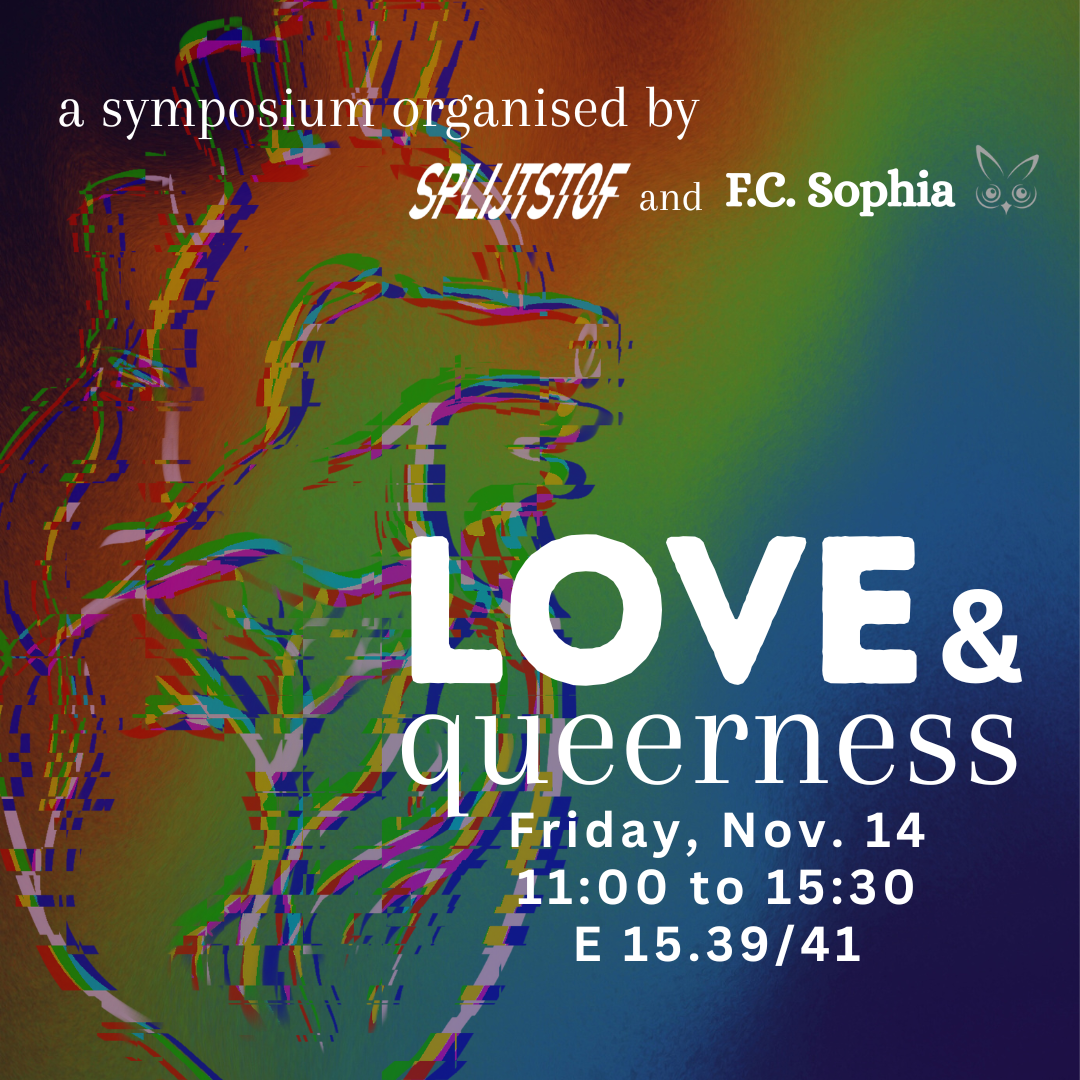
Splijtstof and F.C. Sophia invite you to join this year’s symposium!
The theme is “Love & Queerness” and we have put together a truly interesting and inspiring line-up of speakers. There will be a workshop, lectures, a poetry recital and lots of space for your own questions.
So join us on Friday, November 14 from 11:00 to 15:30 in E. 15.39/41.
Feel free to (quietly) come in at any point during the day. Registration is not requried but please note that seating and space are limited.
Schedule:
11:00 Welcome Snacks and Walk-In
11:15 Love Letter Workshop with author-in-residence Benny Lindelauf
12:30 Dr. Guilel Treiber: “Queer Experiences: Rereading Foucault’s History of Madness”
13:15 Break
13:35 Dr. Rae Aumiller: “Queer Hesitation and Sensation: Navigating Embodied Consent and Doubt” + Discussion with Charlie Chowdhry
14:20 Poetry Recital by Michael Grooff
14:50 Ilyasse Ouanani: “What is Platonic Love? Eros in the Lysis, Symposium, and Phaedrus”
15:30 Ending and Drinks at Cultuur Café
We are excited to welcome you at the event!
For more information, you can find the lecture abstracts below.
Dr. Guilel Treiber: “Queer Experiences: Rereading Foucault’s History of Madness”
Foucault’s The History of Sexuality: The Will to Knowledge is the foundational text of Queer theory. However, it comes with a problematic legacy, specifically one related to a somewhat flat understanding of identity. This has been noticed and commented on extensively. However, the first volume of The History of Sexuality cannot be taken to be Foucault’s final words on the issue of sexuality. Lynne Huffer makes a convincing claim for why a theory of Queer experience cannot develop from its founding text, but rather must return to the early History of Madness. In this lecture, I will explain this peculiar argument and develop it further by pitting psychoanalytical inspired queer theories against those which sees psychoanalysis, and psychology in general, as part of what Queer theory, and specifically, Queer experience, needs to keep a distance from.
Dr. Rae Aumiller: “Queer Hesitation and Sensation: Navigating Embodied Consent and Doubt”
→ Read Rae’s paper in preparation for their presentation here.
In her response to Levinas in “The Fecundity of the Caress,” Luce Irigaray describes a kind of heightened responsiveness that begins from a space of isolation “before the caress.” The caress before the caress is a space of suspended self-certainty, in which touch may question itself. The caress before the caress indicates a relationship to intimacy underlying each instance of touching, which that touch cannot fully grasp. This talk locates a queer, feminist ethics of intimacy, born from experiences of isolation, waiting, disrupted belief, and suspended desire.
Ilyasse Ouanani: “What is Platonic Love? Eros in the Lysis, Symposium, and Phaedrus”
Talk of Platonic love abounds in our contemporary world, but what might such a love actually be? Following this question, this talk proposes to trace the theme of Eros through the Lysis, Symposium, and the Phaedrus. Plato’s dialogues are rife with sexual innuendo, tension, and desire. How does this fit with our common conception of Platonic love as asexual or celibate? Plato sublimates desire, love, into philosophy. What does this look like? I propose, against most scholars, that the Lysis is an erotic dialogue. Socrates answers the question of a demonstration in erotic conversation by engaging in dialectic, because this is erotics for Plato. In the Symposium, love returns as elevation in the famous ‘ladder of love’, elevation to the mysterious Forms. In the Phaedrus, love is presented as mutually beneficial if its sexual attraction is properly rerouted towards philosophy. Throughout these dialogues, Plato turns seduction and sexuality into philosophical practice, he socratizes sex. As such, the philosopher’s love and desire are never fulfilled but perpetually frustrated, and this frustration becomes the engine of thought. Platonic love is not sexless then, but rather rethinks sex in order to make it useful to the aims of philosophy.