Categorie: Events

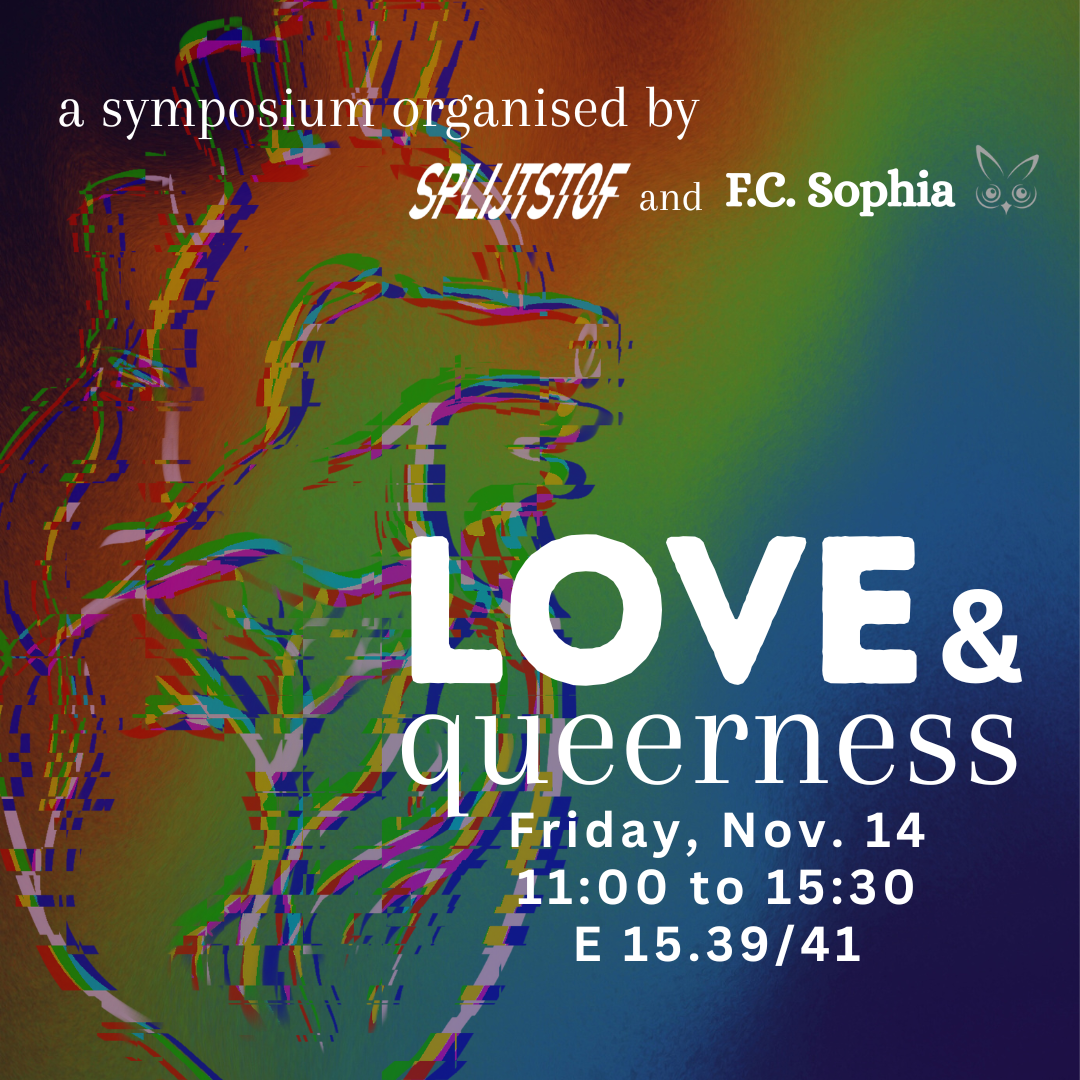
  • Love & Queerness: Symposium with Splijtstof and F.C. Sophia

    Splijtstof and F.C. Sophia invite you to join this year’s symposium!
    The theme is “Love & Queerness” and we have put together a truly interesting and inspiring line-up of speakers. There will be a workshop, lectures, a poetry recital and lots of space for your own questions.

    So join us on Friday, November 14 from 11:00 to 15:30 in E. 15.39/41.
    Feel free to (quietly) come in at any point during the day. Registration is not requried but please note that seating and space are limited.

    Schedule:

    11:00 Welcome Snacks and Walk-In
    11:15 Love Letter Workshop with author-in-residence Benny Lindelauf
    12:30 Dr. Guilel Treiber: “Queer Experiences: Rereading Foucault’s History of Madness”
    13:15 Break
    13:35 Dr. Rae Aumiller: “Queer Hesitation and Sensation: Navigating Embodied Consent and Doubt” + Discussion with Charlie Chowdhry
    14:20 Poetry Recital by Michael Grooff
    14:50 Ilyasse Ouanani: “What is Platonic Love? Eros in the Lysis, Symposium, and Phaedrus”
    15:30 Ending and Drinks at Cultuur Café

    We are excited to welcome you at the event!
    For more information, you can find the lecture abstracts below.

    Dr. Guilel Treiber: “Queer Experiences: Rereading Foucault’s History of Madness”
    Foucault’s The History of Sexuality: The Will to Knowledge is the foundational text of Queer theory. However, it comes with a problematic legacy, specifically one related to a somewhat flat understanding of identity. This has been noticed and commented on extensively. However, the first volume of The History of Sexuality cannot be taken to be Foucault’s final words on the issue of sexuality. Lynne Huffer makes a convincing claim for why a theory of Queer experience cannot develop from its founding text, but rather must return to the early History of Madness. In this lecture, I will explain this peculiar argument and develop it further by pitting psychoanalytical inspired queer theories against those which sees psychoanalysis, and psychology in general, as part of what Queer theory, and specifically, Queer experience, needs to keep a distance from.

    Dr. Rae Aumiller: “Queer Hesitation and Sensation: Navigating Embodied Consent and Doubt”
    → Read Rae’s paper in preparation for their presentation here.
    In her response to Levinas in “The Fecundity of the Caress,” Luce Irigaray describes a kind of heightened responsiveness that begins from a space of isolation “before the caress.” The caress before the caress is a space of suspended self-certainty, in which touch may question itself. The caress before the caress indicates a relationship to intimacy underlying each instance of touching, which that touch cannot fully grasp. This talk locates a queer, feminist ethics of intimacy, born from experiences of isolation, waiting, disrupted belief, and suspended desire. 

    Ilyasse Ouanani: “What is Platonic Love? Eros in the Lysis, Symposium, and Phaedrus”
    Talk of Platonic love abounds in our contemporary world, but what might such a love actually be? Following this question, this talk proposes to trace the theme of Eros through the Lysis, Symposium, and the Phaedrus. Plato’s dialogues are rife with sexual innuendo, tension, and desire. How does this fit with our common conception of Platonic love as asexual or celibate? Plato sublimates desire, love, into philosophy. What does this look like? I propose, against most scholars, that the Lysis is an erotic dialogue. Socrates answers the question of a demonstration in erotic conversation by engaging in dialectic, because this is erotics for Plato. In the Symposium, love returns as elevation in the famous ‘ladder of love’, elevation to the mysterious Forms. In the Phaedrus, love is presented as mutually beneficial if its sexual attraction is properly rerouted towards philosophy. Throughout these dialogues, Plato turns seduction and sexuality into philosophical practice, he socratizes sex. As such, the philosopher’s love and desire are never fulfilled but perpetually frustrated, and this frustration becomes the engine of thought. Platonic love is not sexless then, but rather rethinks sex in order to make it useful to the aims of philosophy.

  • Splijtstof Student Conference: Submission Information and Criteria

    The editors-in-chief at Splijtstof are excited to invite Splijtstof editors and all other students to submit abstracts for philosophical conference papers written on the theme of ‘Disease’. The conference will take place on December 4, 2025. We can accommodate your requests with regards to the relative timing of your presentation on the day (e.g. you can present later if you have a class). All finished conference papers, regardless of whether or not they are presented at the conference, will be published in a special Conference Edition of Splijtstof.
    We are looking for submissions from Bachelor, (Pre)-Master and Research Master students. You are welcome to work together with other students on a conference paper as long as every contributor is named as an author. Submissions should be written in English.

    The use of Generative AI and/or Large Language Models (e.g. ChatGPT) is strictly forbidden at every stage in the writing and editing process.

    Unfortunately, to ensure that this rule is adhered to, we must ask you to write your abstract and your paper entirely in Google Docs, so that we can look at the version history. If we cannot see the version history, we will not be able to accept your abstract or allow you to present your paper at the conference.
    Please send an edit link to your finished work, in a timely manner, to redactie@splijtstof.com. The following dates are hard deadlines.

    Timeline

    October 20, 23:59 – Abstract Submission Deadline
    October 23 – Acceptance Notification
    November 20, 23:59 – Final Version Submission Deadline

    Presentations

    Each conference presenter has 30 minutes to use as they see fit. You should be prepared to present your paper and answer some questions from the audience. If you wish, you may present for a shorter time and use the remainder of your time to guide the audience through a plenary discussion or activity designed to assimilate the content of your conference paper.
    You will not be able to use a slideshow or powerpoint presentation. You are welcome to provide the audience with printed handouts (relevant artwork, instructions for an activity and such), but in the interests of sustainability, we ask you to consider only printing handouts if it is strictly necessary. If you would like to have images on a screen behind you as you present, please send a
    maximum of 5 images alongside your Google Docs link submission (N.B. send the images as separate attachments, not just embedded in your Google Document).

    Abstract requirements


    250 words with a 10% margin, excluding the (working) title and references.
    It should work with the theme of ‘Disease’. You are free to interpret the theme however you wish; both straightforward and creative engagements with this theme are welcome.
    Your abstract (and final paper) should be philosophical. This will mean something different from person to person. We are happy to receive submissions from writers with a non-philosophical background. Write with your own understanding of philosophy in mind.

    Other requirements

    If you plan on going beyond the presentation & question round structure, please use a subheading under your abstract to explain your plan. It will not count towards the word limit, but nevertheless, please be brief.
    Please include your first name, last name, pronouns and current degree programme with your submission, along with any relevant previous education or research interests that relate to your paper. We will use this information to introduce you as a speaker during the conference.

    Review process

    For Splijtstof editors:
    Due to the nature of the submission process, we cannot review your abstract anonymously. The editors-in-chief will review your abstract themselves rather than with the wider Splijtstof editorial team.

    For external participants:
    The editors-in-chief will be aware of who has written which abstract, but the abstracts will be presented anonymously to the rest of the Splijtstof editorial team for review.

    Relevant for all participants:
    When we review your abstract, we are looking for a clear link to the theme of ‘Disease’, a philosophical approach, a description of the structure and methodology of your completed conference paper, and (if relevant) a well thought-out description of your plan for your additional activity or discussion.
    Some papers translate better to a conference setting, and this is another factor we will consider when reviewing the abstracts. In celebration of your hard work, we will be publishing a
    Conference Edition following the event, and every abstract and paper submitted for the conference will be featured, regardless of whether or not the paper was presented during the conference. Thus, it is still worth continuing to work on your conference paper even before you have received the acceptance notification, since it has a place in the Conference Edition of Splijtstof regardless of the verdict.

    Questions/Contact
    You are welcome to contact the editors-in-chief of Splijtstof by email at redactie@splijtstof.com.
  • RAGweek Nijmegen Events in Collaboration With Splijtstof

    Alongside Radboud University’s Faculty of Philosophy, Theology and Religious Studies Student Council and the faculty’s student associations, F.C. Sophia and Awaz, the Splijtstof team has organised two exciting new events in collaboration with RAGweek Nijmegen.

    RAGweek Nijmegen is affiliated with the RAGweek foundation, an organisation dedicated to raising funds for, and awareness of, two charities each year: one based in the Netherlands and one based abroad. This year, the chosen Dutch charity is Stichting Kinderfeest, and the international charity is Bring the Elephant Home (Africa & Asia).

    Accordingly, we are thrilled to officially announce our involvement in the following events:

    April 9, 2025RAGweek Charity Market
    Come along to shop at various market stalls offering baked goods, art, and much more. Funds raised will be handled by RAGweek Nijmegen and distributed to this year’s chosen charities outlined above.
    12:15 – 13:30
    Radboud University’s Erasmus Square
    April 11, 2025RAGweek Colloquium and Feedback Event
    Present your (unfinished) research to a small audience and receive constructive feedback! You can also leave a printed-out copy of your writing with the Editors-in-Chief of Splijtstof (English) or our Dutch-language editor, and we will provide suggestions and corrections. Pay-what-you-can donations to RAGweek are greatly appreciated.
    12:00 – 18:15
    Radboud University’s Erasmus Building, E15.39/41

    Questions?

    What if I don’t want to present anything at the colloquium but would love to hear about ongoing student and staff research in the FTR faculty?

    Come along and join the discussion!

    I would like to present at the colloquium, but I don’t know what is expected of me. What should I prepare?

    We welcome research presentations in any form! The colloquium is a relaxed environment where you are welcome to present any research, at any stage, in any form. You can prepare as much or as little as you would like. We do not expect to receive any documents from you beforehand, but if you would like to make a donation to RAGweek Nijmegen in exchange for editing and proofreading services from our Editors-in-Chief, a printed copy of your writing would be appreciated.

    From whom can I receive feedback at the colloquium?

    A variety of FTR researchers, professors and lecturers have been invited to the event as guests. You can also receive feedback from your fellow students, alongside the Splijtstof editorial team.

    What if my question is not listed here?

    You can contact the Editors-in-Chief of Splijtstof via email at redactie@splijtstof.com.

    External Links

    RAGweek Nijmegen: https://www.ragweeknijmegen.nl/.

    Stichting Kinderfeest: https://stichtingkinderfeest.nl/.

    Bring the Elephant Home (Africa & Asia): https://bring-the-elephant-home.org/.

  • Splijtstof Student Conference: ‘Fantasy’

    28
    November2024
    Splijtstof Student Conference: ‘Fantasy’
    10:00 – 17:00Radboud University’s Erasmus Building: E15.39/41

    The Splijtstof Editorial Team is proud to present their first student conference, based on the theme of ‘Fantasy’!

    You are invited to attend a day of philosophical inquiry into ‘Fantasy’ and its manifestations in various specialisations, from object-oriented ontology, critical disability studies, philosophy of technology, animal ethics, political philosophy and much more. The event will take place from 10:00 – 17:00 on November 28, 2024, in Radboud University’s Erasmus Building (E15.39/41). It will be moderated by Dr. Rae Aumiller (Metaphysics and Philosophical Anthropology), Tim Miechels (PhD Candidate in Metaphysics and Philosophical Anthropology) and Sophie Ingle (Ethics and Political Philosophy).

    The Splijtstof Student Conference has been organised in collaboration with Tim Miechels.


    Schedule

    10:00 – Welcome

    10:10 – 10:40 – Jonathan Zackor – An Infinite Present Without Consequences: The Absurd Promise of Liminal Space

    10:50 – 11:20 – Marleen van Haalen – The Realness: What the Fantasy of Drag Can Teach Us About Reality

    11:30 – 12:00 – Panel Discussion on ‘Fantasy’, Drag and Reality with Dr. Rae Aumiller, Tim Miechels, Marleen van Haalen and Charlie Chowdhry

    12:00 – 13:00 – Lunch

    13:00 – 13:30 – Charlie Chowdhry – Disabled Dreams of Accessible Academia: Fantasy, or Feasible?

    13:40 – 14:10 – Saar Boter – Frutiger Aero: A Fantasy of a Better Future

    14:20 – 14:50 – Sophie Ingle – Phenomenological Reflections on Donaldson and Kymlicka’s Liminality in a Fantasy World of Pokémon

    14:50- 15:10 – Break

    15:10 – 15:40 – Susana Reis – CRISPR and The Fantasy of Human Immortality: Using Imagination to Assess This Possibility

    15:50 – 16:20 – Jacque Marliin – Narrating Self-Destruction: Hegemony and Nihilist Strategy
    An Alternative Interpretation of David Fincher’s Fight Club

    16:30 – 17:00 – Mark den Dekker – The Fantasy of Capitalism: How Capitalist Ideology is Literally Magic

    17:00 onwards – Drinks in the CultuurCafé

  • Splijtstof Student Conference: Call for Abstracts

    The editors-in-chief at Splijtstof are excited to invite Splijtstof editors and all students of the FFTR to submit abstracts for philosophical conference papers written on the theme of ‘fantasy’. The conference will take place on November 28, 2024, at E15.39/41. We can accommodate your requests with regards to the timing of your presentation. All finished conference papers, regardless of whether or not they are presented at the conference, will be published in a special Conference Edition of Splijtstof. 

    We are looking for submissions from Bachelor, (Pre)Master and Research Master students. You are welcome to work together with other students on a conference paper as long as every contributor is named as an author. Submissions should be written in English. 

    Please submit your abstract as a .docx file, in a timely manner, to redactie@splijtstof.com. The following dates are hard deadlines. 


    Timeline

    October 7 – Abstract Submission Deadline

    October 11 – Acceptance Notification

    November 14 – Final Version Submission Deadline

    Presentations

    Each conference presenter has 30 minutes to use as they see fit. You should be prepared to present your paper and answer some questions from the audience. If you wish, you may present for a shorter time and use the remainder of your time to guide the audience through a plenary discussion or activity designed to assimilate the content of your conference paper. 

    You will not be able to use a slideshow or powerpoint presentation. You are welcome to provide the audience with printed handouts (relevant artwork, instructions for an activity and such), but in the interests of sustainability, we ask you to consider only printing handouts if it is strictly necessary. 

    Abstract requirements

    250 words with a 10% margin, excluding the (working) title and references. 

    It should work with the theme of fantasy. You are free to interpret the theme however you wish; both straightforward and creative engagements with this theme are welcome. 

    Your abstract (and final paper) should be philosophical. This will mean something different from person to person. We are happy to receive submissions from writers with a non-philosophical background. Write with your own understanding of philosophy in mind. 

    Other requirements

    If you plan on going beyond the presentation & question round structure, please use a subheading under your abstract to explain your plan. It will not count towards the word limit, but nevertheless, please be brief. 

    Please include your first name, last name, pronouns and current degree programme with your submission, along with any relevant previous education or research interests that relate to your paper. We will use this information to introduce you as a speaker during the conference. 

    The FFTR’s rules concerning plagiarism, academic integrity and the use of Generative AI apply to this conference. That is, write with integrity and do not have anything or anyone else do it for you. 


    Review process

    For Splijtstof editors: 

    Due to the nature of the submission process, we cannot review your abstract anonymously. The editors-in-chief will review your abstract themselves rather than with the wider Splijtstof editorial team. 

    For external participants: 

    The editors-in-chief will be aware of who has written which abstract, but the abstracts will be presented anonymously to the rest of the Splijtstof editorial team for review. 

    Relevant for all participants: 

    In your abstract, we are looking for a clear link to the theme of fantasy, a philosophical approach, a description of the structure and methodology of your completed conference paper, and (if relevant) a well thought-out description of your plan for your additional activity or discussion. 

    Some papers translate better to a conference setting, and this is another factor we will consider when reviewing the abstracts. In celebration of your hard work and a significant Splijtstof milestone, we will be publishing our first Conference Edition following the event, and every abstract and paper submitted for the conference will be featured, regardless of whether or not the paper was presented during the conference. Thus, it is still worth continuing to work on your conference paper even before you have received the acceptance notification, since it has a place in the Conference Edition of Splijtstof regardless of the verdict. 

    Questions/Contact

    You are welcome to contact the editors-in-chief of Splijtstof by email at redactie@splijtstof.com.

  • Symposium 2024: Hopes and Dreams

    26April 2024

    Splijtstof Symposium: Hopes and Dreams 13:00 – 17:00Erasmus Building
    E15.39/41

    We are proud to present Splijtstof’s philosophical symposium of 2024, taking place on Friday, April 26. The theme of this year’s event, matching our upcoming 52-3 publication, is ‘Hopes and Dreams’!

    We invite you to enjoy an afternoon of reflective inquiry and discussion alongside our enthusiastic Symposium Committee and wonderful keynote speakers. Following the event, we also welcome you to grab a drink or a bite to eat in the CultuurCafé. This year’s attending keynote speakers are Dr. Wim de Muijnck (Philosophy of Behavioural Sciences), Dr. Nico Adelhöfer (Donders Sleep & Memory Lab), and Prof. Marc Davidson (Philosophical Ethics and Political Philosophy). Each of these fascinating speakers will engage with ‘Hopes and Dreams’, exploring the philosophical implications of these concepts in their respective disciplines. We welcome you to visit our symposium at any time between 13:00 and 17:00 in room E15.39/41 of the Erasmus Building.

    Symposium Schedule:

    13:00 – Gather in E15:39/41, the heart of Radboud University’s FTR faculty on the Erasmus Building’s 15th Floor

    13:15 – An introduction to ‘Hopes and Dreams’ by our moderator

    13:30 – Lecture by Wim de Muijnck: ‘Escaping from an Open Cell’

    14:15 – Break time in the Coffee Corner of the Erasmus Building’s 15th Floor

    14:40 – Interview with Nico Adelhöfer: ‘What is Lucid Dreaming?’

    15:40 – Lecture by Marc Davidson: An Environmental Ethics Approach to ‘Hopes’

    17:00 – Drinks at the CultuurCafé

    Any changes to the schedule will be announced via @splijtstof on Instagram and updates to this webpage.

    We look forward to seeing you soon!

  • Symposium 2023: Bodies and Embodiment

    27
    September 2023
    Splijtstof Symposium: Bodies and Embodiment
    13:00 – 17:00Erasmusbuilding

    Splijtstof is proud to present the annual philosophical Symposium, which this year will take part on the 27th of September! The theme of this year’s Symposium will be: Bodies and Embodiment.

    Feel welcome and be submerged in an afternoon of philosophical activity, ending with a drink at the CultuurCafé. The speakers which will be attending this year are Ea Utoft, Ilse Meijer, Josias Tembo and Vivienne Matthies-Boon. All of these speakers will shine their light on Embodiment, what it means to them and how we – as dedicated philosophers – must question and interact with certain aspects of embodied life. If you feel like stopping by, which is possible whenever you want during the 27th, you can find the Symposium in room E.15:39/41, from 13:00 until 17:00.

    Schedule for the day:

    13:00 – Gather at E.15:39/41 on the 15th floor of the Erasmus Building

    13:10 – Welcome and start of the day by moderator Max Schmermbeck

    13:30 – (E.15 39/41) Ea Utoft and Ilse Meijer: A Discussion on “Objectivity” and Embodied Research Methods

    14:40 (E.15 39/41) Lecture by Josias Tembo: Towards an Embodied View of Race and Religion

    15:25 – Breaktime in the coffee corner on the 15th floor of the Erasmus building

    15:50 – (E.15 39/41) Lecture by Vivienne Matthies-Boon: A Critical Phenomenological Account of Long Covid

    17:00 – Drinks at Cultuur Café